Sunday, August 16, 2015

The gold in the Golden State

Spending years three through ten in Central and Northern California I have a warm spot for the rolling hills and Oaks that epitomize the area. From our last California dwelling we could hike the foothills above San Leandro which in the late forties were barren of development. There was an outcropping where we would enjoy a picnic lunch and that we named Eagle Rock or so I remember. To the surprise of absolutely nobody that open space is now a sea of modest homes. It was at Lake Chabot, a county park nestled in those hills, that I was stung by about a million bees. There was crying involved if I’m not mistaken.

Earlier, in our end of the war Salinas days, we often ventured to Monterey, Pacific Grove and Carmel. That would have been by public transport since didn’t have wheels until more than a decade later. Our path from Salinas took us through the very landscape that that these photographs depict. Those grassy knolls and hillocks say California like nothing else. 

On the morning that I photographed Harold and Pat Glasco, the subjects of last week's post, I made some early morning photographs of a glowing hillside that had just been shorn of its Wheatgrass. That left the graded soil the color and texture of a Jersey cow and made the iconic Oaks really pop.


Then, for good measure, there are these golden rollers reaching down to the Pacific between Cayucos and Cambria.
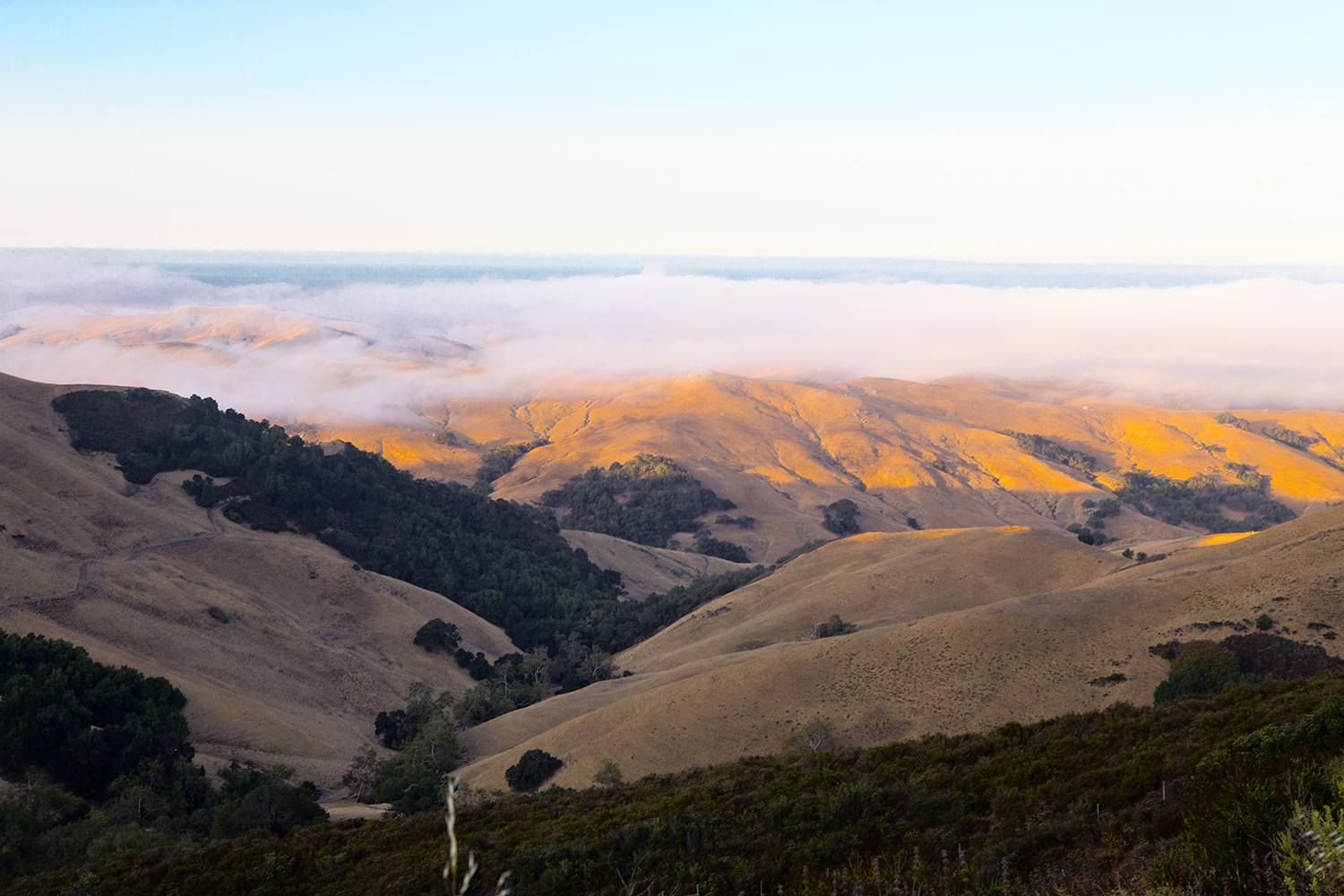


Middle California's decor package starts with tan carpet spread across undulating hills from San Diego's North County to the upper reaches of Sonoma. That's the better part of 400 miles south to north and fifty miles across from the coast to the San Joaquin Valley. That's enough acreage to make it the dominant feature of coastal Cal. It makes me wonder what the early Spanish must have thought when they beheld such an Eden.


Sunday, August 09, 2015

Harold and Pat Glasco

Harold and Pat Glasco

Harold and Patricia Glasco were high school sweethearts in mid-1950s Oklahoma. In 1973 during his successful career selling construction steel Harold and his bride bought 37 hillside acres of Paso Robles grass and oaks for the princely sum of $850 an acre. They had it paid off by 1992 and today are sitting on a gold mine of Central Coast farm land. It's a vineyard waiting to happen.

Bindi and Harold

As I was photographing the rolling hills and wineries west of Paso Robles I saw Harold tending his Longhorn “Shorty.” So called I imagine because of the length of his horns, When he had finished his ministrations he pulled alongside for some chit chat and next thing I knew I was at the top of the hill meeting Pat and learning about their path to this extraordinary place. Harold would be the first to say that they were blessed.

Harold in his garden of machinery

He’s a loquacious guy, a great storyteller and a born salesman. He gave me the grand tour of their hilltop aerie which was laden with farm equipment in various states of repair. He showed me the well and pump he himself installed and the rainfall jottings he logged every year. Once it was 50 inches a year. Last year it was 10.

Later that night back at my motel Harold called to tell me that he had forgotten to show me a cave on his property and that I should come back the next day. A dark o'clock start up the coast precluded that so I’ll have to take a raincheck from my new friend.   

Sunday, August 02, 2015

Valley Dry

A tinder dry nut farm west of Wasco where our business is roses and prisons

Heading west toward Paso Robles on Highway 46 the California drought grabs you by the throat. California’s San Joaquin Valley, the fruit basket of the nation, is described in textbooks as “semi-arid” but right now it looks like the westward migration of the Mojave Desert. At least that’s the case without irrigation.

More and more plots are lying fallow as precious water is preserved and signs offer sprawling parcels of farmland but attract with few buyers.

Prime farmland or soon to be beachfront property near Blackwell's Crossing where James Dean met his maker.

What do you call an irrigation ditch without water? Desert.
At Blackwell's Crossing with the Coast Range in the distance


Sunday, July 26, 2015

How dry I am

Beauty shot of Lake Nacimiento.

Lake Nacimiento is but a shadow of its former self. After three years of the much ballyhooed drought California it has become a forlorn symbol of the disappearing surface water that plagues the Golden State. Today the lake holds 24% of its deemed capacity, a paltry 90,313 acre feet of the robust 376,304 acre feet it once held. The shrinking lake looks like a bathtub with more and more rings being added with each passing month.

To my untrained eye the lake has fallen nearly 100 feet in depth and has withdrawn from its former shoreline by hundreds of feet. Herein are images to justify my estimates.

Look like a hundred feet to me.

The boat launch from the ever receding shoreline. Note the erstwhile floating docks left and right.

New water line.

From the new water line to the shore that once was.

This one adds no new information but the two women lend poignancy to the tan tableau

Yup. That's somebody's boat dock dangling above the shrinking lake


Locals have all their digits crossed that the El NiƱo winter happens as forecast. More to come from the tinder dry central valley.

Sunday, July 19, 2015

The staff of life I'd say

Wood fired oven bread from Wild Flour Bread in Freestone, California

It occurs to me that there’s another gift to be found in bastions of farm to table fare and vineyards and that’s the great bakery. They’re the boulangeries of France, the panadarias of Spain and the artisan bakeries of Sonoma and West Marin. Even a tiny burg with 200 inhabitants may sport such an establishment. Such was the case when my host at Canvas Ranch said I had to visit the Tomales Bakery, open Thursday through Sunday morning, calling it the “best bakery in the world” and I quote.

Tomales Bakery in tiny Tomales, California

Fresh baked goodies including the raspberry chocolate concoction to right

Pie filling from scrumptious Sonoma peaches

Some kind of bun, undoubtedly delicious

I’m indicting the Tomales Bakery in Tomales, the Bovine Bakery in Point Reyes Station and Wild Flour Bread in Freestone as co-conspirators in a four pound assault on my boyish figure in six days in Paso Robles and Sonoma and Marin Counties.

Bovine Bakery in Point Reyes Station with it's ever present line

Bovine Bakery pastries

Wild Flour Bread at the corner of Bohemian Highway and Route 1 in Freestone. This incredible place sits just across the street from the Joseph Phelps Tasting Room. How convenient.

Manning the woodfired oven at Wild Flour

Note the pile of fresh bread behind the blonde lass. I devoured the best bread I've eaten since pain ancienne in in Riez, France in 2011.

Previously I’ve made the case that where wine grapes grow other marvellous foodstuffs flourish and good restaurants abound. You can add really good bakeries making really good bread to these markers of good living.

Awhile back Peggy were making a list of attributes that any new place we’d chose to live would have to have. A good bread bakery was high on the list. Fresh produce, too. Let’s just say that the Sonoma and Marin Coasts score 100s on the Immel Good Living Index.

Some of these images are on the smallish public domain side. It wasn't till I got home that I concluded that good bread may just be the soul of good eating and of a truly advanced culinary community. In fact, I'm pretty sure that's the case.

Sunday, July 12, 2015

The verdant and the dessicated

All along l-40 in New Mexico the colors were saturated and the sky scrubbed clean by rain, some of it torrential. California not to much.

This is the kind of photography a guy produces through windshields and side windows at 80 mph. That is to say, not very good and the best is yet to come. Can't get worse.


A salad of Cowgirl Creamery Burrata and Exeter, California Elberta Freestone Peaches tossed with Blackwell's Corner Almonds and accompanied by a bracing Tablas Creek RosƩ from Paso Robles is in the offing. All of this and much, much more to be enjoyed in my trim little cabin on the Canvas Ranch just east of the village of Tomales between Petaluma and the Pacific.

Without my external monitor the values and colors of these shots are very much a crap shoot. Be gentle with me.

Sunday, July 05, 2015

Downright Upright

There’s been considerable discussion around here about the days of film and chemicals in dark confined spaces and I’m not talking about adults only theaters. It’s just that some of us of a certain age are getting all misty about those eight hour bouts with a single negative and how that process must have rendered a superior image.

Then again the transition from celluloid to pixels hasn’t been all that damnable looking back.

Here are some shots that track that evolution and that, I submit, make the switch downright upright according to me.

From my 1941 8x10 Kodak 2D using a 4x5 back almost 45 years ago

With the 5MP Nikon Coolpix 5000 in maybe 1999

And the 10MP Canon 1Ds that cost me $7,700.
This one's from the same 10MP unit with a 48" softbox and lens 15" away from Mizahn's face

In the village of  Monieux with the 21MP Canon 5D Mkll


Sunday, June 28, 2015

High Country

When I joined Cuba on his way to summer pasture he was camped in a field about 18 miles west of US 285 on FR 87. I had figured I’d find him around mile marker 16.  At 18 miles or so I encountered a ranger moving east on 87. I asked if he had seen a flock of sheep. He said he had seen them around 9 AM by the corral at the junction of FR 87 and FR 133 but not since. That seemed odd to me and I was concerned that they were hidden in the Aspens off the road.

I needn’t have worried because scarcely a mile up the road were Cuba, his campo and the borregos. It’s hard to miss 400 sheep grazing fifty yards away.


Cuba came out to meet me and told him I had a photo album for him. “Tengo un libro de fotos para usted.” He leafed through the book and was beaming from page one. Victor likes the camera and the camera feels the same.

I  chatted with him for an hour or so and knocked back one of his Pepsis. That’s my annual ration. I clarified some facts namely that he did come to the US in 1965 as I had understood and he had spent five years in Florida and three more in California picking apples. That was new history and I still need to account for the five years between 1973 and 1978.

I asked what he had done in Cuba he said he herded sheep and cattle. When I asked why he left he said simply, “Gobierno malo.” Not much of a revolutionary I guess.

I drove a mile or so up 87 to pitch camp and after settling in went back to spend more time with Victor. I shared some tangerines with him and he brought me three tamales in return. He tried to unload some fried chicken but I demurred claiming "lleno."

He's a sweet man.

It was the next morning that I learned from patron Andrew Abeyta that Cuba had given notice as I reported last time. Then he, Cuba and the dogs pointed the sheep toward Las Lagunitas and the next night’s camp.


Sunday, June 21, 2015

The Last Shepherd


Well it’s finally happened. Cuba has tendered his resignation and Los Abeytas are looking for a new herder from South America, Peru in all likelihood. The working title for the book I hope to write about Cuba, the sheep and the Abeyta clan is “The Last Shepherd” which is sounding most apt just now. 

The retirement of Victor “Cuba” Hernandez as El Pastor, the shepherd, of the Abeyta flock comes on the heels of his 76th birthday earlier this month. He's earned the right to while away his days surrounded by his own small herd of goats and his adoptive family in Mogote. According to my math, the gentle soul has spent 333 months in solitude since Amos Abeyta hired him in 1978, Cuba says 1975. That, for the bean counters among you, is 27.75 years by himself in the dusty reaches of the Taos Plateau and lush meadows in the high country beyond San Antonio Mountain.


Sunday, June 14, 2015

The long and sweet of it

Panoramic photography is the stock and trade of my friend Terry Thompson.  The guy’s the master of the form. Still there’s the occasional subject that makes me want to taste the forbidden fruit. There’s a sunflower farm just west of Fort Garland, Colorado that prompted that particular urge one summer day.


For the real deal check out Terry's extraordinary images at www.terrythompsonphoto.com 

Sunday, June 07, 2015

Up close again

Back at the start of this adventure or at least the digital part thereof I spent most of my time photographing things close up. At one time those subjects were called Studies and Abstractions, the name of my first show, and later a more focussed permutation called Found Art. When shopping for a subject for today’s post I scrolled through the archives and uncovered a couple that would be at home in either category.

35 rocks and a shell

Honey Bee Lookin'

Back in the early days of digital I thought tight shots were my bag and that landscapes were my weak suit. Was told that by an esteemed photographer and teacher as a matter of fact. But then things swung to bigger and broader and that's where I'm finding the most success. Just go with what grabs you I suppose because that's where the satisfaction lies.