Saturday, June 29, 2013

The earth is flat


The McCullough potato operation is an all natural enterprise and not just for altruistic reasons since quality has gotten better and better since going native.  Puh-leeze don’t use the term “organic” around Jim McCullough.  The word organic has been so misused, abused and downright lied about that it's nearly useless.  We'll go with natural.

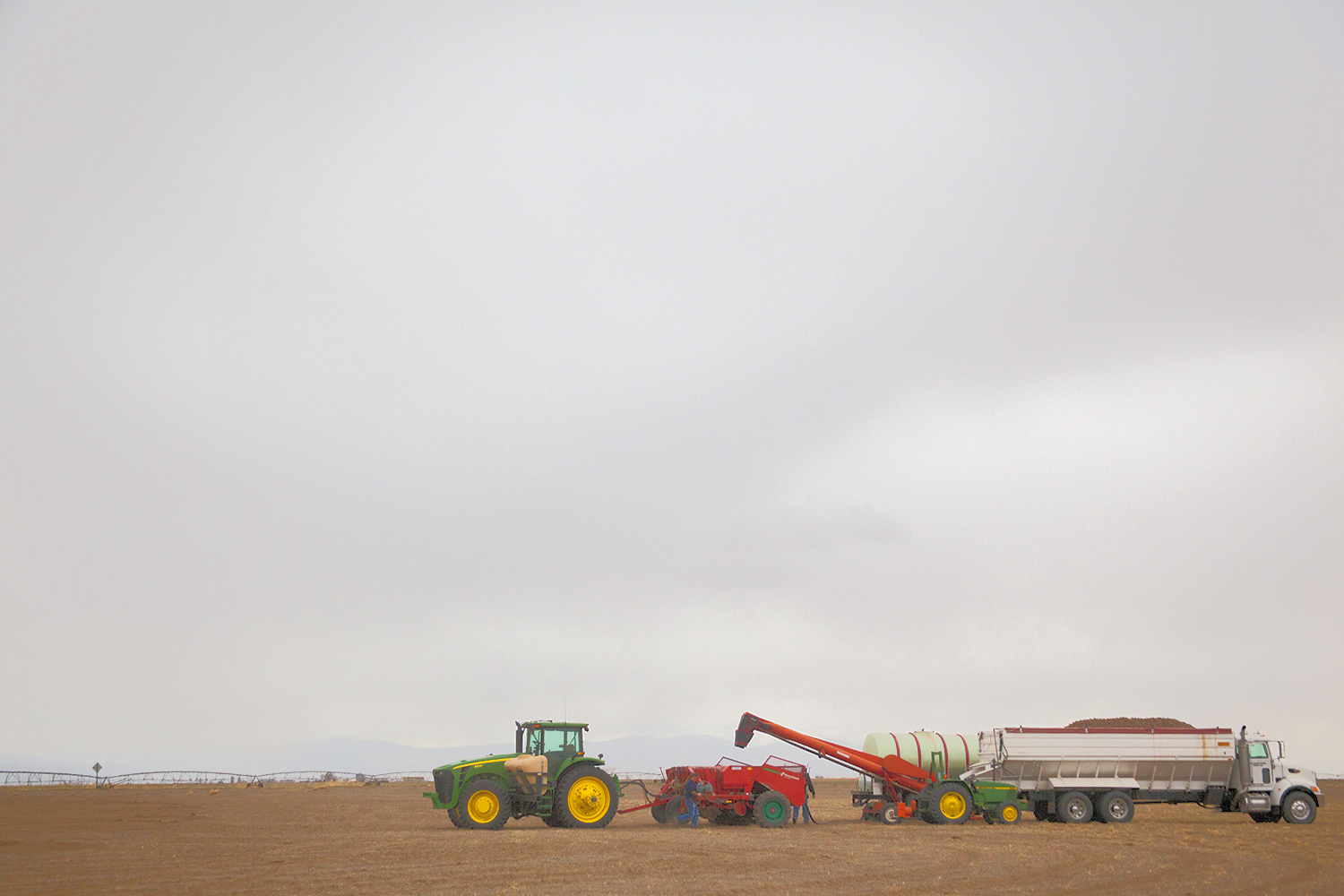
Jim controls every step of his operation.  Unlike some farmers, Jim plants, fertilizes, harvests and warehouses his own potatoes.   His team literally invent and build equipment to do jobs that others farm out.  And every decision to keep these big jobs in house has paid off with improved quality and lower costs.  Jim claims he wasn't a school learning kind of guy but you could go to school on his business savvy and intuition.


The top three images have little to do with the potato story but the furrowed fourth is one of Jim McCullough's fields being planted. The abandoned farm house that is about to be leveled and the grain bins, those aesthetic corrugated cylinders, are not potato icons though they do speak to farming generally.  And, of course, since they're all platinum toned black and white they must be serious photographs.

The San Luis Valley has been described as pancake flat.  Uh huh.

Sunday, June 23, 2013

The same only different

I intended to follow up with more of the potato story.  Oh but no. It’s funny how an unruly subject can interject itself at the most opportune time.  I must have needed a single image post. 

This one of my good friend Lindsey Enderby is from a couple of years ago.  I like it because it shows the bonhomie of this son of Gainesville, Texas.   Plus it reminds me of the iconic hat back and a lick of hair shot of Will Rogers, another cowpoke with a heaping measure of humor and kindness. 

Anyway, this one seems appropriate since Lindsey and his bride Nancy have just sold their cowboy emporium, Horse Feathers, and are now retired folks like some other people I know.  In truth this is a bittersweet moment since I along tens of thousands (I tend to inflate) of other strays first met Lindsey in the store and wound up as dinner guests at the Enderby homestead.

And where will I idle away my Saturday afternoons now?  

Sunday, June 16, 2013

One Potato Two Potato


A few weeks back I was able to photograph the planting at Jim and Sue McCullough’s mega potato operation in southern Colorado’s San Luis Valley.  City mouse that I am I had no idea that when you plant potatoes you literally plant potatoes.  Sue, a regular painting partner of Peggy’s, had been dangling the chance to photograph the McCullough spread for it seems like a year and I have finally begun my introduction to the complex and oh so equipment intensive business of producing 1,400,000 hundred weight of potatoes.  So this is a major deal.  It is not a timid undertaking or one to be attempted without a full measure of cojones.  And speaking of cojones, Jim says, “You have to have potatoes available when buyers are buying even if some years you lose a little on every sale.”  You're a player or you're not.  So, the intrepid McCulloughs bank, that's the operative word,  on a high yields and high prices most years.  That means reinvesting, re-thinking and re-engineering the business constantly.  Jim aspires to produce and sell 2,000,000 hundred weight of Russets and has a plan in place, which is to say in his head, to do just that. 


This story that will require shooting the sprouting vines around the Fourth of July and the harvest in early fall.  Then there’s the warehousing, packing and distribution extravaganza that is a low light nightmare.  Get ready for a rush of motion blur.

This story has a lot going for it.  It’s new turf.  It’s learning about the dusk to dawn farming lifestyle.  And it’s in my beloved San Luis Valley with the McCulloughs as my hosts.  Big thanks to them. 


Sunday, June 09, 2013

The sky opened and the earth shook


The sky has loomed large in painting and photography from the beginnings of each art form.  A dominant sky demonstrates power, scale and a mythic glimpse of the heavens like nothing else.

Big skies and empty deserts are natural collaborators.  They reflect each other’s vastness.   The Mohave among all deserts draws me and that attraction has been reflected here often.  Though all deserts share the attributes, if that word can apply to negatives, of an odd and meager human population, of abundant and desiccated icons of that habitation and a desperate austerity, the Mohave is more muy malo.  All deserts are inhospitable and forbidding but the Mohave is El Rey of badness. 

When we saw the monumental sky over the desert to our east we immediately got off the Interstate between Kingman and Needles, fingers crossed that we hadn’t missed the moment.  Getting the memorable shot, Ansel Adams and Henri Cartier-Bresson would testify, is often a matter of seconds and we had few to spare.   Adams, for example, claims he had a minute to take Moonrise Over Hernandez back in 1941 and that he didn’t even have time to meter.  Myth or fact, the tale illustrates a truth. 

You know that sky had to be special for me to stop.  I’m not, shall we say, much of a stopper.  That’s the burden of being an A personality I suppose.   But as a psychiatrist friend has often said, “We have therapies for this.”  And the therapy is stop for the damn shot. 

Has anybody noticed that the titles of my posts are often song lyrics?  And, if so, what’s the name of the tune from which this title came?

Sunday, June 02, 2013

The time of firsts

Continuing the long look back we visit Salinas where I spent two or three early years at the end of the Second World War.  It was in Salinas that my first memories were etched including my first movie, my first best friend, my first crush and first food memory.  I remember that my first film was one starring Esther Williams, my first crush, and featuring a young Latin heartthrob, Ricardo Montalban.  It was either Montalban or the other handsome Latino actor of the forties, Fernando Lamas.  According to Ms. Williams’ filmography the movie must have been Fiesta which was released in 1947.  In an unlikely turn of events Montalban did the voice-overs on television commercials for a Mexican restaurant chain that I operated in the late seventies.  I didn't make that connection until this moment.  Esther Williams is 91 and lives with her third husband in Beverly Hills.  

Both downtown theaters still exist as live music venues and since I have no clue which one ran Fiesta here are both.


My best friend was Ramon Gutierrez who lived with his mother  Sally and his grandmother is a little court where my mother and I rented a bungalow.  Big Ramon was a prisoner of war in Japan who, because he was a gardener by trade and used in that capacity by his captors, came back home relatively whole since he could steal food.  Others were not so fortunate.

I have already told the story of my first food epiphany but it bears repeating since I was apparently born to eat.  On brisk winter afternoons after playing in the slough behind the house Ramon’s grandmother would make flour tortillas and roll them around melting butter. Nothing has ever tasted better or been more soul warming.  I’m convinced that my love affair with food sprung from that seminal experience with the lowly tortilla and I could probably weave my life’s story through the tastes that have punctuated it. 


Sunday, May 26, 2013

Cowboy Tendencies

Old corrals evoke a sense of the west like few other things.  They're icons of a rough, tumble and self-reliant life on the American frontier.  In lots of ways that man against the elements sensibility still lingers in today’s western life.  And I do I believe that every boy wants to be a cowboy.  It's been true with me since my first pair of boots from Porter’s Western Store in the Santa Rita Hotel in downtown Tucson.  The year would have been 1951 if memory serves.  The smell of saddle leather ranks right up there with corrals, Wranglers and trophy buckles in stirring the cowpoke within.

Corrals like any subject can be photographed from infinite perspectives.  Sometimes, though rarely in my case since I'm such a purist, a little experimentation is in order. Here are a panorama and three other images all of which were made from two to five vertical photographs that have been stitched together.  The intent is to render more detail and acuity without the noise that can occur in very large prints made from smaller files.  My friend Terry Thompson is a master of the process and I claim no authorship of the technique.  
The corral in question resides just off Highway 285 near its junction with the road to Carson.  The ramshackle affair with its Sangre de Cristo backdrop speaks to the vast and epic place that is northern New Mexico.

Sunday, May 19, 2013

Playing Games


From shortly after World War Two till 1975 Fort Ord was the main basic training center for Army recruits in the western United Sates.  In 1990 it was closed and morphed into a state university, several housing developments and a strip mall with an REI.  Its easternmost acres became Laguna Seca Raceway.  At the time it was the largest army post to suffer the indignity of being shuttered.

Basic Training was a rite of passage for thousands of young men including this feckless fellow.  The Army or at least the Army Reserve version of same was a reprieve from a rocky first year of college in which my budding career as a folk singer and established career as a beer drinker kept my eye far from the academic ball.  And that puts it mildly.


Anyway, Basic is a mythic hurdle for the callow and immature.  Just entering the presumed depths of hell makes a boy’s knees quiver. In reality, it was easy if you played the game of playing soldier and Basic was a lot like play.  I really got into those manly forced marches, shooting Expert with a WW ll era M1 and the wearing tailored and starched fatigues that had other trainees saluting me until they got close enough to see there were no bars on my lapels.  Even got a bid to go to OSC (Officer Candidate School), heaven forbid.  I can see it now, shave tail Second Lieutenent Steve Immel leading a squad of grunts in some rice paddy in Viet Nam.   Or much, much worse.

Ted Newman, another folkie from Phoenix, was also at Fort Ord.  Ted, who was a couple of years older, had enjoyed a minor hit in 1959 called “Plaything.”  Nick Todd, Pat Boone’s younger brother, also covered the tune on Dot Records.   “Plaything that’s all I was to you.  Some tricks.  Your little game is through.  Right now, stop knockin' at my door?  I'm not your plaything anymore.”  Pure poetry.

Ted and his Martin held court on Carmel's Main Beach every Sunday and I followed suit; a Beach Blanket movie without Annette and Frankie.  I don’t know if Ted was authorized to leave the post.   I know I wasn't but, hey, the south gate was unmanned.

Ted became an Army helicopter pilot and an elementary school teacher in Gilbert, Arizona and Nick became a social worker.   I opened forty restaurants over forty years.  That's forty opening nights.  I win.
 
On the flip side the vacant hulks of the old barracks take a mournful turn.  They proffer an aching postmortem for the fort and for the youthful energy that filled these spaces half a century ago.  The murals from that era and the graffiti from this one compete for our attention.  Abandoned and empty, the derelict halls echo with the voices of raucous young soldiers and the billows of smoke that accompanied them.  The words "Smoke 'em if you've got 'em." punctuated every idle moment in this man's Army in the summer of 1960.


Sunday, May 12, 2013

Moss Landing


The Salinas River enters the Pacific just below Moss Landing.  I have the faintest recollection of being there in the mid-forties and seem to recall that its icy waters were a mecca for sport fishing.  Today its home to 300 humans and 500 boats, larger even than Monterey itself.   A former whaling port, the harbor now docks vessels fishing for King Salmon, Halibut, Albacore, Black Cod and Red Snapper.

In the seventies Moss Landing had descended into an abyss of pollution fueled by failed septic systems, a paucity of infrastructure and nasty effluent from the natural gas powered electric generator that dominates the skyline.   Several lawsuits and many millions of dollars of public dollars later the tiny village has recaptured some of its earlier glory.  A marine research facility operated by Cal State University and Monterey’s famed aquarium debuted the weekend after my visit.  One hopes that the new laboratory signals a return of the pristine shore and waters of my childhood.
Empty beaches offer serenity with a dollop of melancholy especially in fog or overcast skies as it was this day.  I shared Salinas Beach State Park with a solitary walker and driftwood sculpture from Mother Nature’s damp studio.


Sunday, May 05, 2013

As the face of the moon


When I hear Zabriskie Point two thoughts spring to mind.  One, of course, is the famed Death Valley landmark and the other is Michelangelo Antonioni’s failed 1970 film of the same name.  The photogenic locale endures as a photographic magnet and Antonioni’s panned 1970 paean to sixties counter culture endures as a cult classic replete with dialogue by Sam Shepard and music by Jerry Garcia, the Rolling Stones and Pink Floyd.  In it Harrison Ford had an uncredited role as a jailed student protester.   The movie ending five minute slow motion explosion fantasy with Pink Floyd’s Careful with the Ax beneath the bombast is worth the trip.  Pun intended.


Zabriskie Point is part of the Amargosa Range and of the Furnace Creek formation in eastern Death Valley.   It’s described as badlands which I take to mean dry, inhospitable and desperate.  In other words beautiful.  From the main vista point spreads a 360 degree view of otherworldly tucks, folds and creases of rock and of the desert floor stretching to the Black Mountains in the distance.  Zabriskie is often portrayed abstractly with the convolutions in the rock photographed without the context of the broader landscape.  And as with other iconic locales producing a transcendent image is a result of some skill and more luck.

Zabriskie Point is a Soviet code for a location on the moon and couldn't be a more apt for this barren moonscape.  But it was actually named for Christian Zabriskie the general manager of Pacific Coast Borax Company whose twenty-mule teams transported the borax from its Death Valley mines.  Anybody remember Death Valley Days from early television?  Who was its host? 


Saturday, April 27, 2013

Kudos to Kelp

Three Stones and Surf

The Point Lobos was described by Tasmanian landscape painter Francis McComas as “the greatest meeting of land and water in the world.”  He left this earth in Pebble Beach so he certainly thought so. Still that’s some lofty lingo to describe a tiny, rocky headland.  There are legions of Mainers who would put Acadia and Monhegan into the ring with the Central Coast contender any old time.  Weston battles Wyeth in a steel cage death match.

Sea Foam

Part of the rocky part of the rocky headlands

Kelp in black and white

Kelp in Color
Unhappily for me I erased two memory cards from our recent California sojourn, erased that is before downloading the images.   So half of what I could have shown and told about Point Lobos has vanished into nothingness along with half my shots from the former Fort Ord where I majored in Army Basic Training and minored in AWOL on Carmel's Main Beach during the summer of 1960.  


Sunday, April 21, 2013

California Dreaming

Point Lobos Morning
To say that California is a trove of topographic diversity puts it mildly.  With Mediterranean, Alpine, and three desert ecosystems to mention just a few the Golden State has about every kind of terrain you could want.  In the course of three trips there since November I’ve spent five weeks seeing just a fraction of its bounty and reckon I'll be back for more. So much state and so little time.
 
Within this wide array reside two iconic photographic locations, Point Lobos on the Central Coast and Zabriskie Point in Death Valley.  Both have lured generations of photographers most notably Edward Weston at Point Lobos just a football throw away from his house on Wildcat Hill.
Zabriskie Point
Here are three images from a week ago, one from Point Lobos, one from Zabriskie Point and one from the oak flecked hills above Carmel Valley.  The soft shouldered meadows of California’s Central Valley represent the Golden State like nothing else to me.   They may lack the drama of the shore and desert but they color my first childhood memories in Salinas and San Leandro.
Oaks and Meadow, Coastal Range
Remember to click on the images to see them full size.  The tall state needs a big screen.


Sunday, April 14, 2013

Cactus Flower

After a week in California you’d think I’d post something from the Golden State but, alas, the computer gremlins have been in attack mode so I’m going with something from the archives.  The cactus hails from Ghost Ranch and, since we were just there, the image seems timely or at least excusable.  There’ll be precious little verbiage with this one since the gremlins have prevailed and I'm retreating to fight another day. 

Sunday, April 07, 2013

Working Hands

From time to time I pull a golden oldie out my hip pocket.   Such is the case with this one of a codger and his pen knife making a whistle from a pea pod.   We found our fun anywhere we could back in the hardscrabble 1830s I can tell you that. 

The scene was Old Sturbridge Village in western Massachusetts in the early 1970s and may have been at Thanksgiving.   We enjoyed several Thanksgivings at Sturbridge when we westerners gloried in the colors, tastes and rich history of New England.  New England became our true home, the place where we spent thirty years, our children became adults and my restaurant career flourished and flagged till I rode off into the sunset 10 years ago.

Our gambrel colonial home in Ipswich was the Dennis Dodge house built in 1740.  Replete with seven fireplaces, a Jacobean staircase and a walk in fireplace with a beehive oven in the kitchen the house was magic to me.  My drive home from my office in Burlington was a 45 minutes of freeway travel and never did I regret the trip or stop relishing my return.  Garrett was baptized by Edward French at the Episcopal Church down the street.  French who had been John Updike’s Harvard roommate drove a 1968 Mercedes convertible, my favorite vehicle ever, and was married to a fiery redheaded Ballantine heiress.  Updike had also lived in Ipswich but had moved to Georgetown, Massachusetts with his former mistress and now wife.   I could write a book.  Oh wait, Updike did that.  It was a potboiler called Couples.

Old Sturbridge Village is a living museum in Sturbridge, Massachusetts which recreates life in rural New England from the 1790s through the 1830s. The Village includes 59 antique buildings, three mills and a working farm.  Customed interpreters like our old friend share the mysteries of early nineteenth century life with visitors from around the globe.
This image unlike the large format portrait posted on March 18 is from a scanned 35mm negative.

Sunday, March 31, 2013

Fade to Black

These remarkably lifelike silk roses sat on a table near the window in an abandoned house in Bethlehem, New Hampshire.  They were photographed through a window though it’s not evident in the image.  The window gave enough illumination to provide highlights up front but allowed the background to fall into shadow.  That mix of light and shadow gives the flowers a sense of depth and of volume.

Bethlehem, a picturesque but threadbare resort town on the western slope of New Hampshire’s White Mountains, is famously a summer vacation destination for Orthodox Jews from New York.  The heady stew of Hebrew signs, Stars of David and New England farmhouses is eclectic and tinged with humor.   Green Acres meets Borough Park.   Gefilte fish and cider.  Yamulkes and bibb overalls.  Make me stop! 

Sunday, March 24, 2013

Not so fast

A week ago spring flickered and I went for my first road bike ride of the season.  Temperatures approached 70 and all was right in the world.  Then Mother Nature had a change of heart and arctic cold blasted and blustery winds swept across the mesa.  Fickle witch.  It was 11 degrees when I picked up the Sunday Times this morning and I’ll be back on the damnable stationary bike watching old Tour de France videos by this afternoon.

On the plus side winter's resurgence sets the table for a long overdue addition to my Sketches of Winter series.  I’ve neglected the poor thing. 

Sunday, March 17, 2013

Is it that obvious?

Last week I charted my journey into the digital age and wrote of my years with cumbersome large format cameras.  This nugget was taken forty two years ago in Minneapolis.  The camera was a wooden Kodak Model 2D 8"x10" View Camera made by the Folmer Graflex Company of Rochester, NY around 1941.  It was and still is a thing of beauty, an artifact unto itself.  For years it stood near a window in our dining room in Massachusetts, an angular sculpture of cherry and brass, an icon of the midcentury photographic process.  Today it’s folded into its weathered leatherette case in the garage.  It’s one of the last vestiges of hours beneath a black hood composing upside down images in ground glass.  I doubt that I’ll ever part with it.

I bought the camera, three vintage lenses, a Simmon Omega D2V enlarger and a complete darkroom set-up for $250 in 1971.  Shortly thereafter the photograph above emerged from the Dektol, Fixer and Hypo Clearing Agent.  The lenses reside on a shelf in our loggia here in Taos.   Old lenses are among the perfect forms along with guitars and the female turn of hip.  Like the camera, lenses are elegant reminders of the big camera era and of storied practitioners lugging behemoth rigs into places like Yosemite, Point Lobos and Oceano. 

Looking back, my large format images were made in the style of those masters, perhaps too much so. They were too studied and too obvious in their reverence for their forebears.  Still those were exercises that helped develop a skill set; a foundation in the basics of composition, exposure, depth of field and the darkroom alchemy that applies to the digital darkroom just as it did in the wet one for nearly forty years. 
Images of the 2D and assorted lenses may follow.

Sunday, March 10, 2013

Never Look Back

My journey to the dark side began with two photographs taken more than ten years ago.  One, Agave, was taken at San Marino California’s Huntington Garden with a five megapixel Nikon Coolpix 5000 camera and was so startling in its sharpness and tonal range that I began to see my future in photography.  Until that moment I had been a dyed in the wool large format guy but was being seduced by a sweet little image from a pocket camera. 

Still, that fall I bought a spanking new Cambo 4x5 from Calumet Photo in Cambridge, Massachusetts.  I put my beautiful Schneider Symmar 180mm f5.6 on that puppy and spent early winter learning my new gear.  Then in March, if memory serves, Canon introduced its 1DS with whopping 10.1 megapixels of resolution.  As the first truly high resolution digital camera the 1Ds blazed the trail into the megapixel frontier.  The unprecedented resolution was not the only thing outsized about the 1DS.  It listed for , gasp, $7,999 which was some pretty serious cake for 2003.  But then I did have a trip to Provence scheduled and a digital SLR kit would be smaller and lighter and I did already have a couple of Canon lenses I could use.  And I did buy the thing for $7,700 didn’t I? 

Right after getting the camera I took some shots of fresh picked squash at a farm stand in East Conway, New Hampshire.  It had just stopped raining and was still overcast so the light was beautifully diffuse.  Later that evening when I processed the images I was floored by the acuity and the silvery midtones that I saw.  The photographs looked like they were made with a 4x5 and there was no grain whatsoever.  In that moment I knew I was destined for a digital path, a path that led me back into photography with a vengeance. 

I never shot with a large format camera again and sold my whole big camera shebang to Oakland High School in California for a few hundred bucks.  And the rest, as they say, is history.

Sunday, March 03, 2013

There's close and there's really close


Railyards are ripe with subjects that can be interpreted abstractly.  Chunky mechanicals cry out for such treatment in my opinion.  That makes the Chama and Antonito yards of the Cumbres and Toltec Railroad perfect places to take closer look.  That’s closer as in look down closer, get in tight closer and limit what you see to what’s right there in your viewfinder closer.  This is not the time for the grand vista.  This is a killer drill for learning to see and for designing arresting abstracts. Hey, I’m as fond of a locomotive or caboose as the next man but trucks really get me going. 


What is a truck you ask?  A truck is a railroad wheel assembly that has two or more axles.  They're much like the wheels on your favorite skateboard which are also called trucks.  Get that thing out of the closet and take a look.  Ties, you know what they are. But what are the other things shown below?