Sunday, November 13, 2022

Natural Attachment


Adobe and fresh snow are a magical pair. The tufts of fluff attach themselves to the rough spots on the mud and straw plaster as if magnetically drawn. Darts of snow, snowflakes driven diagonally down, punctuate the quiet and bring a layer of complexity to the scene. Even the splotches of wet snow on the camera lens bring vitality to the scene below.


Two miles southeast of the Martinez Hacienda featured in last week’s post resides the most photographed building in the Southwest if not the whole country. Paul Strand and Ansel Adams portrayed the handsome San Francisco de Asis in the 1920s and 1930s and every tourist with a point and shoot camera or smartphone gets their record shot. Having made several thousand shots on, say, fifty occasions I can attest to the challenge of rendering something special. Lenny Foster, late of Taos and now of St. Augustine, managed two doozies, one of the back of the church with crows in flight and another from atop a crane for a remarkable vantage point. My alleged best have been of details of the doors, crosses, canales and, especially, the buttresses taking center stage today.

To me the fine coating of wet snow on the accents the sensuous curves of the buttresses.

Sunday, November 06, 2022

First Snow

Early 1800's wagon

Crumbling buttress with front and north wall.

The first meaningful snow is a delight. It cloaks the landscape in a soft pillow of muted sound and heaviness. We woke to three inches of wet fluff Wednesday morning, and I was compelled to photograph the late fall marvel at two historic locations nearby. A scant half mile south of Casa Immel resides the Hacienda de Los Martinez, the northern most grand hacienda in New Mexico. Built in1804 the sprawling Hacienda is a robust symbol of Spanish colonization with a rich history to tell. The snow fell lightly, and wet puffs clung to the moist earth, the wagon and the canales. The stone body of the front facing northern buttress had given way to the elements. The Hacienda was in grave need of a fresh coat of mud and straw so I figured the cash strapped Taos Historic Museums couldn’t afford its annual mudding or enjarre.

Buttress and long side wall.

Canal #1

Canal #2

The 21 room Hacienda was constructed as a fortress to repel Comanche and Apache raiders. It had two inner courtyards or placitas where the livestock were kept during attacks.

Next week I’ll visit historic San Francisco de Asis Church in Ranchos de Taos two more miles down NM 240. 

Sunday, October 30, 2022

633 to 9


I’d need a trailer to carry my Profoto studio lighting setup. Between the power supply, the two strobes and the 2’x4’ softboxes plus the cables, stands and Pocket Wizard triggers it’s a monumental effort to assemble the kit. I scarcely ever use it. It would be hunky dory if I could leave it set up but that’s not the case. And to take it on the road is a laughable proposition. Portability and environment portraits in the field are my dream. I may have found my dream package.


As a happy birthday to me gift in September, I bought myself a vastly more portable Godox strobe kit and compromised by buying just one softbox which I hoped would approximate the power and diffuse light of the Profoto gear.


Two evenings last week Peggy and I photographed each other with good if not great results. I didn’t think the light was as soft as the term softbox suggests. I could work with it but wasn’t blown away by any stretch. That meant I needed a portrait victim. I immediately thought of my photographer friend Terry Thompson who would tolerate my bumbling efforts. Happily, Terry’s response to my request was an enthusiastic “I’d like that very much.”

Wednesday, I repaired to Casa Thompson for the first official portrait session with my new Godox kit. Two hours and 633 shots later, Terry and I skimmed through all 633. I told him that I wanted to produce at least a few images that did him justice. He responded. “You’ve accomplished that and then some.”

I said, “I think there are at least 50 worthwhile photographs here. I'll process all of them and give you with a thumbdrive of the best ones.”

One day and six hours later I had winnowed the 633 to 185 promising images. Sunday after another four hours I reduced the so-called “Selects” five times until I had 20 photographs on my short list. Here are the last ones standing. Yeah, I know nine is too many for a blog post but I didn’t want to sacrifice any of them.

Sunday, October 23, 2022

Hither and Yon

Between the Brazos Cliffs overlook and Tierra Amarillo is big sky wild west cattle country. Note the band of golden aspen on the horizon.

The cliffs as seen from 10,000 feet on US 64.

A meadow along the scenic Santa Barbara Canyon Trail.

Cloaked by clouds in Santa Barbara Canyon.

Applied blur in the canyon.

Here’s a grab bag of shots from the Brazos Cliffs as seen from the high point of US 64, of sprawling rangeland on the flats beyond the cliffs and from Santa Barbara Canyon which slices into the Sangre de Cristo Mountains outside of PeƱasco, New Mexico.

Sunday, October 16, 2022

Same Time This Year

Just ahead is the shallow rise to Hopewell Lake at 9,500 feet.

Golden aspen and meadow beyond Hopewell Lake.

It was only after I drove northwest on US 64 to the height of land past Hopewell Lake that I realized that I’d made the same trek on the same day and time for three years running. It was the second Sunday in October of 2022 when the lure of full color in the high mountains of northern New Mexico couldn’t be ignored. Like the sandhill crane to the Bosque de Apache in November I was bound for 10,000 feet of autumn wonder.

The flats between Tres Piedras and ascent to Hopewell Lake are picture book cowboy country.

As evidenced by this throwback scene northeast of Tres Piedras.

I was running an hour too late for getting the best morning glow, so I grabbed a huevos, chorizo and pico de gallo burrito at Toribio’s in El Prado and blasted for the heights 45 miles away.

On the same terrain long ago and far away.

It was a glorious destination on a Kodachrome morning, but the best light had passed. So, I’ve compiled a handful of fall color images made on this and other October excursions to favorite locales. More to come.

Sunday, October 09, 2022

Note to Self

Mark Asmus is still 6'6", has maintained muscle mass and carries himself like a young man.

Understandably most conversations with peers turn to age, ageing and the insidious encroachments our afflictions, injuries and limitations are making on our bodies and psyches. Every few weeks my friend Mark Asmus and I meet for lunch to sort the world’s festering ills and to contemplate our inevitable descents to less than we are now. He and I have approached or entered our eighties relatively unscathed but recognize that our good luck can go sideways in a heartbeat. We’re surrounded by evidence of that reality.

Both of us look at certain of our fellows living lives we hope not to live. And we worry about our tolerance for frailty and serious discomfort. We think we have little.

I told Mark, “I’m not hung up on duration which is not to say I want it to end. I’m one hell of lot more interested on the quality and the content of what’s left.” You’ve heard me say it too many times. I must believe it.

He concurred with my premise and said we should talk more often even if we are in an echo chamber physically, socially and politically.

The topic and the spirit of our talk wasn’t a dark as it sounds. He and I see the inevitability of losing health and function as an admonition to enjoy the hell out the Good time that’s left. Italics provided for emphasis.

I reiterated my belief that you don’t want to look back and say, “I wish I had.” And, further, what’s wrong with my contention that our mission in life should be to enjoy ourselves, and to have experiences that excite us and that we'll remember always?

A couple of weeks back I got an eblast from a high school mate whom I haven’t seen since, well, high school.  He had learned how many members of the illustrious Class of 1959 at Tempe Union High School have departed for a different place. 62. Yup. Sixty-two members of our class of 185 have returned to the earth or the ozone or wherever the hell our corporeal selves are deployed when we stop inhabiting them.

His cover message was a downright chipper, “It sounds pretty amazing to me.” That one-third of my classmates have been rocketed to Bye-Bye Land sounds like crap to me, Larry. I still want and still can do just about everything I’ve ever wanted to do. And, importantly, the spirit, and hunger for adventure burn bright. The rub, so far, isn’t the ability. It’s the will and temerity to make it happen.

Do what you want to while you still can. If one third of your contemporaries have departed planet earth take note. Make the adventure you’ve been putting off happen. Master Spanish, blues guitar, or quantum physics. Kiss your loves ones more. Much more.

If I’m sitting in a wheelchair sporting a catheter whether I’m 82 or 91 and I’m lamenting that I didn’t do what I wanted to do when I could do it I won’t be a cute little old man.

I know this. Aside from Mel Brooks and Norman Lear there are no young 90-year-olds.

Sunday, October 02, 2022

Encounters of the First Kind : Peter Larlham

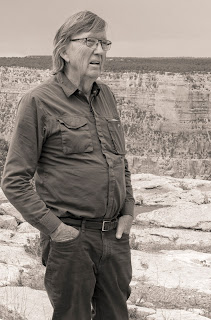
Peter Larlham at Pima Point.

My first conversation with Peter Larlham began with a shudder. In his first breath he asked my age. This being the day after my 81st birthday he found me in a weakened state. I had not taken the event well. 81 sounded more like a death sentence.

To compound the felony, he expressed amazement and intimated that my demise was nigh.  

“That’s really old. I’m 76.” As if that were prepubescent.

I whimpered, “But I don’t feel 81.” I lied.

Both of our in-depth conversations turned to aging and the malicious manifestations of that malady. Bad back. Worse balance. Replacement parts. Shrinkage. Flabby stomach and no ass. Scoff if you must. Every man I know of a certain age has lost muscle mass and most of it vacated his nether regions. Peter quoted a line from Shakespeare in which an elderly gentleman laments that he no longer fills his “pantaloons.” I am guilty as charged. My buttocks are absent without leave.

I introduced you to Peter last time. He’s the chap I met at the Grand Canyon two weeks ago, the affable storyteller of mythic proportions. Peter, as you may recall, grew up in Africa and was schooled in Africa and England before getting his Ph.D. in Theatre at NYU.  He told me he attended boarding school for 12 years. While attending school in England he came home to Africa once a year whether he needed to or not. It’s an existence that seems classically British and aloof to a white bread American kid of the 50s like me.

He said he was lucky to pass his exams so he could attend university. He chose Natal University in Durbin, South Africa, a city on the Indian Ocean which boasted a heady stew of Native Africans, Indians, and the English. It sounded idyllic. 

When Peter arrived at Natal, he and his best mate looked down from a hill overlooking the campus and observed a building where a steady stream of girls were entering and leaving. Peter turned to his friend and proclaimed, “That’s the school we’re going to attend, Alfie.” So, Peter’s career in theatre was spawned by raging hormones. The bard, the boards and the babes beckoned. He met Margaret his future wife of 51 years at Natal and retired as a Professor of Theatre at San Diego State University after 36 years. Imagine Peter’s story if the long line of lovelies in Durbin had been aspiring nurses not actors.

He told me he awarded only A’s his last five years of teaching. “Who am I to judge an art form?” he pondered. Who indeed.

On the first day of class in his very last semester of teaching, he saw an unfamiliar face in the classroom. He asked her name. She wasn’t registered for the class according to his list of new students. When questioned she replied, “I’m not. But I didn’t come to class at all last semester, and you still gave me an A. So, I decided I might as well see what I missed.” You and I can ponder the efficacy of the straight A model but it's a great story well told.

Two experiences foretold Peter and Margaret’s lives and careers in the U.S. They honeymooned in New York City in 1972 and fell in love with the freedom and vitality of America. The contrast to Apartheid Africa couldn’t have been more stark. In a moment of riveting clarity Peter describes that revelation and a second moment when they knew they had to escape Africa.

Their young son had just drawn a picture of a British Colonial soldier on horseback shooting a Zulu warrior through the heart. In drawing the warrior’s heart is gushing blood. His son’s teacher patted the boy on the shoulder and told him, “Excellent job, Lewis.”

“That’s when I knew we had to get out of Africa.” Peter told me.

Peter Larlham speaks Zulu and wrote the definitive book on Black Theatre, Dance and Ritual in South Africa.

Since 2008 he has worked to transform The Mnyakongo Primary School in Tanzania. Appalled by the condition of the school’s library he has returned every year first to build a new one stocked with 8,500 books, then to install electricity and running water and to buy goats to provide milk for school lunches. These efforts expand each year under his impassioned leadership.

For this work he is the first recipient of the Ray Sylvester Phi Kappa Phi Distinguished Service Award for service that extends beyond academia.

And speaking of age, on our last evening of mediocre pizza, tepid pilsner, and zippy repartee he probed a second time, “Aren’t people shocked when you tell them how old you are?”

Sadly, the only one shocked is you, my new best friend. Well, and maybe me.


Sunday, September 25, 2022

Language of the Land

Wagon Ruts was taken on a photo safari down US 285 which crosses New Mexico from the Colorado line in the northwest to the Texas border in the southeast. I was approaching Cline's Corners near I-40 when I saw these tracks heading east to the distant foothills. The contrails top right made the difference on December 3 , 2010.
 
This post kind of writes itself. As you probably know I’ve been a contributor to the online photography magazine, Shadow and Light, for four years now. I’ve been proud to be part of it and it’s helped me hone my writing chops and learn to meet a deadline.

Heading west on my annual wine country jaunt I caught a glimpse of these amazing cliffs and billowing clouds east of Gunnison, Colorado. I got off at the next exit, flipped a U-turn and meandered through a housing development to the height of land next to I-70 where I got this shot. It was August 11, 2013. It's called Book Cliffs because that's their name.
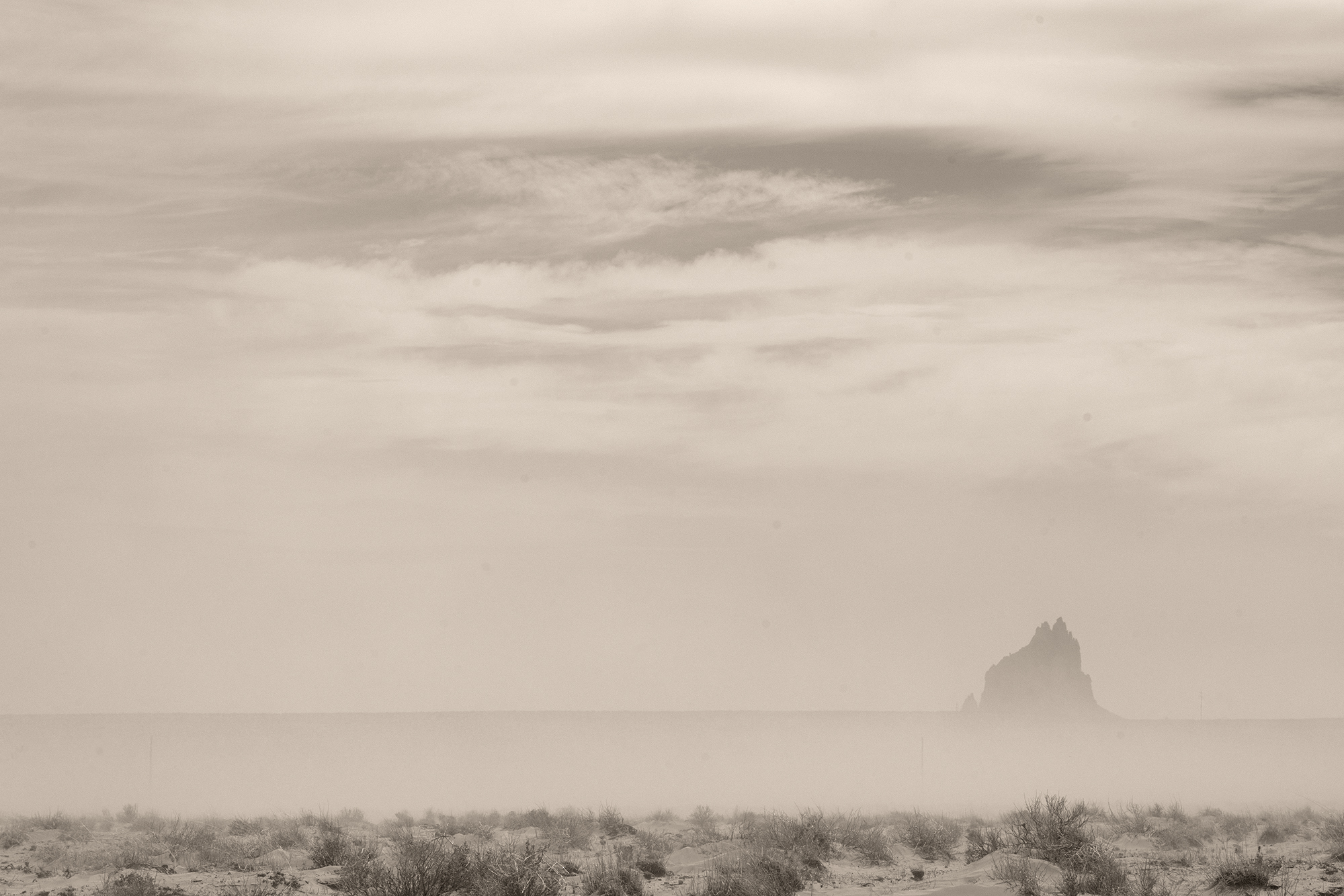
I was caught in a sandstorm with gale force winds near Shiprock, New Mexico this spring. I braced myself against the car and photographed Band of Sand on May 11, 2022.

Walking Rain on the Navajo Nation taken on August 19, 2013.

This Vanishing Point is on the Pine Ridge Reservation near Wanblee, South Dakota on July 5. 2013

I had written my article, What’s Left, for the September-October issue of Shadow and Light only to discover that publisher Tim Anderson was introducing a special issue, Language of the Land. So he would run the September-October story in November-December instead. “You should submit to the landscape issue” he told me, “Some of your stuff could be a fit.” So, it wasn’t a lock, and I knew the competition would be fierce.

When the initial results were published, I didn’t think I’d made the cut and was mighty disappointed. No, the real word is embarrassed. Then I was relieved to find out it was an oversight, and a small portfolio of my black and white images would be included in the issue. If these babies weren’t good enough, I’d have had to resign my commission or commit hari-kari whichever is worse.

Here are the entries Tim’s panel of experts selected from the eleven I submitted. Getting to eleven from many dozens was in itself a dizzying task.

Sunday, September 18, 2022

Canyon Stories


As we wind up our fourth visit to the Grand Canyon in the past three years, I’m faced with three possibilities for my Monday post. One is the obvious, landscapes of the Canyon, the others are more thought provoking and deserve more attention than I can muster Sunday night. I’m running on fumes. So, I’m leaning toward a passel of Canyon shots.


The deeper stories that must be told are, one, about a friend of 60 years and his incredible journey, I visited him for the first time in 20 years last week. Jim’s life is even more stunning than I remembered. If you read his life story as a novel, you’d call it overwrought and implausible. I suggested that he write an autobiography since he has perfect recall of his highs and lows including the dialogue from every juicy encounter. He’s the best storyteller I’ve ever met.  


The second story idea two fits my nascent series Encounters of the First Kind like a glove. These are the profound occasions when you meet, connect, and know a fellow human in a few precious moments.

Peter Larlham is my old friend’s equal as a storyteller. He grew up in Tanzania and South Africa where he met Margaret at Nadal University in Durbin, South Africa. It was during apartheid, and it was apartheid in part that drove them to America. Though white they couldn’t abide the realities of that racist time, especially for their children. Earlier when they honeymooned in New York City they fell in love with the freedom and opportunity they saw in America and swore they would move to the States. Making that happen was a protracted struggle and when they finally made their way to our shores, they were poor and jobless. But once here they created their own American Dream. Peter told me they were lucky. I say they made their own luck. He and I became fast friends over good conversation and beer. He declared that “I don’t usually talk to people like this. It’s really been a pleasure.” The pleasure was mine.

I hope to flesh out these stories but for now here’s a handful of sunsets from the mother of all canyons.

Sunday, September 11, 2022

What's Left, Part Three


Taiban, just east of Fort Sumner which is best known as the place where Billy the Kid was plugged, lies on the empty flats that are indistinguishable from West Texas. Ahead lies Clovis, NM where Buddy Holly recorded his early hits including “Every Day.” The ribbon of two-lane US 60 slices through the arid steppes with only the residue of tiny railroad towns like Taiban to relieve the sameness. In the ghost town that was Taiban is a shuttered Presbyterian church crying out to be remembered. On this day the sky was heavy with sweeping clouds that made a dramatic backdrop for the proud church standing sentinel over the vast nothing. The scene is a showstopper that has corralled many a photographer driving the backroads to somewhere, in our case Dallas. 


In 1906 Taiban was a small ranching community blessed with newly laid railroad tracks. In anticipation of the railroad and the opportunity to own land settlers arrived from across the country. But Taiban fizzled. The 1920 census claims a population of 312 souls and thirty years later in 1950 the number was 206. When the Great Depression hit the railroad station closed and hopes for a robust future in the big empty were dashed. There were two competing factions in Taiban. The teetotaling Presbyterians and the rowdy patrons of the Pink Pony Bar symbolized the divide. The Pink Pony was still serving in 1969 while the church closed its doors in 1950. 

Patterns repeated themselves throughout the West. Communities blossomed briefly and soon fell to earth. The causes varied and often more than one blow brought the place to naught. There was no more water or the water was fouled. The gold or silver petered out. The railroad or the Interstate bypassed the town. Or it was a double whammy. In Keeler the Owens Lake went dry and the Cerro Gordo Mine across the highway went bust. 

On the walls of Taiban's handsome church one of many lines of graffiti tells us, "The sun will rise tomorrow and we'll try again."


Sunday, September 04, 2022

What's Left, Part Two

The availability of water made settlement possible in the first place. Then came the promise of riches beyond imagining and the railroad opened the West to seekers from across the nation. Where abundant water exists so can man. When the water has been depleted and not replenished settlements are left to desiccate in the sun. The Mormons brought irrigation to the Four Corners. And as the Mormons gave life to swatches of Arizona, Utah, and Colorado much earlier the Spanish Conquistadors brought irrigation to New Mexico. The first irrigation ditch was dug in 1598 in Chamita just west of EspaƱola and about 50 miles from where I’m sitting. Their formula was a simple one. Find a water source like a river or lake. Then dig a ditch or acequia to access the water and build a church.

Standard Oil of Rice

Railroad Siding, Rice, California

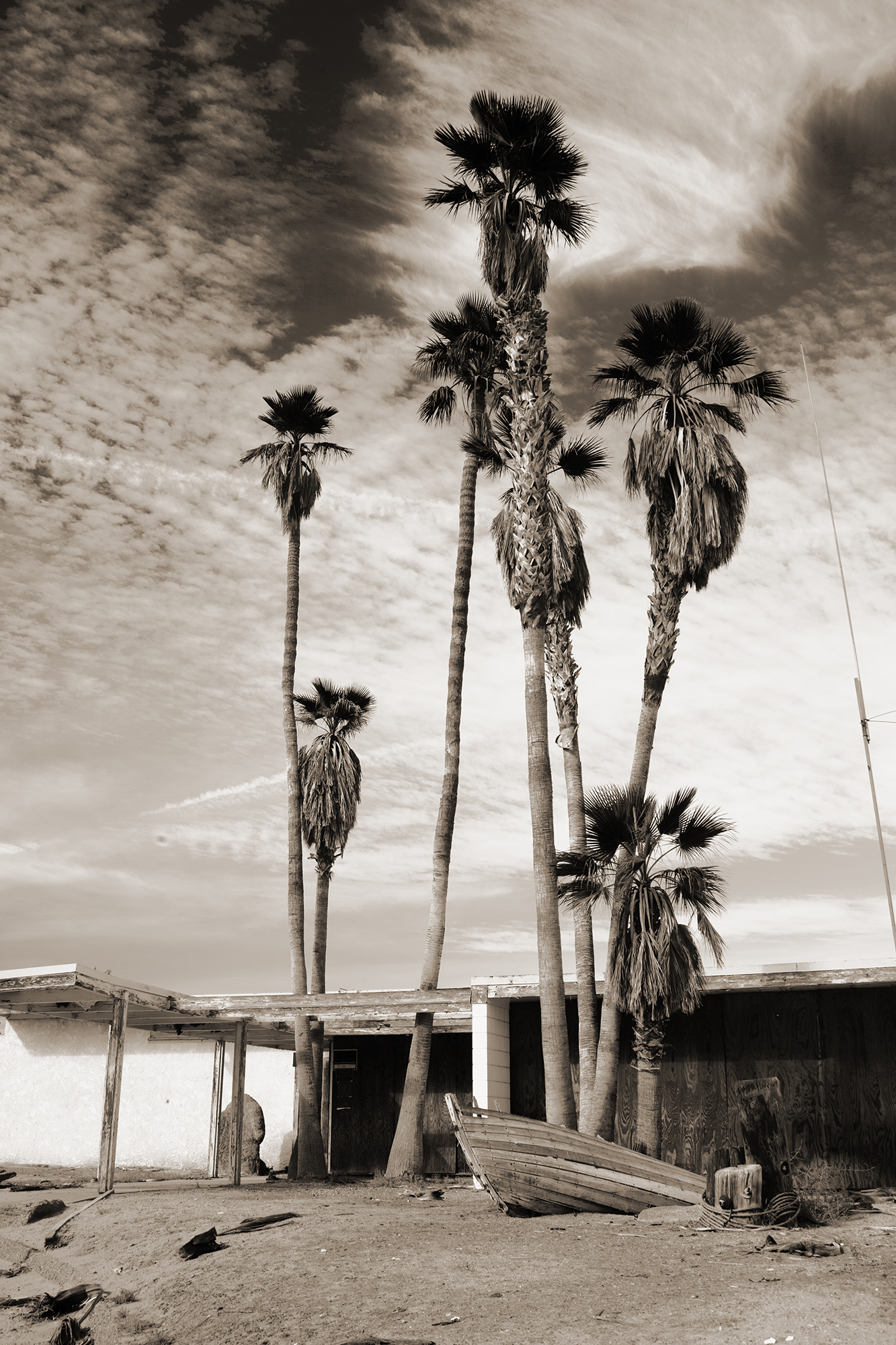
Rice, California at the southern tip of the Mojave Desert began as a Santa Fe Railroad siding. Rice, formerly Blythe Junction, sits at the junction of the dusty road from Blythe and Highway 62 which connects 29 Palms to the west with the Colorado River to the east. What’s left of Rice is long-closed Standard station, railroad tracks and a line of decommissioned cars, that and a well-known Shoe Garden. Rice enjoyed its short zenith when its municipal airport (why there was one baffles me) was acquired by the US Army’s 4th Air Support Command in 1942. During WWll the field employed as many as 6,000 troops and employees.  It lasted about a millisecond in historical terms. It closed and was declared surplus on October 31, 1944. Accordingly, Rice withered and died. Its claim to fame is being the second choice for the world’s first atomic bomb test. It was well worthy of that use.

Yacht Club, Desert Shores

Beautiful Bombay Beach

Just south the Salton Sea once boomed as a playground for the rich and famous. Billed as Palm Springs by the Sea restaurants, shops and night clubs sprung up along its western shore. Frequented by Sinatra and his Rat pack, Jerry Lewis, and the Beach Boys in the Sixties the inland sea claimed the fastest water in the world due to its salinity. During its halcyon days Bandleader Guy Lombardo piloted his 40-foot monster to a world speed record of 118.22mph on a one-mile course. Then two tropical storms in 1976 and 1977 poured so much rain into the sea that it overflowed into all the towns on its shores. And when the water finally receded the salinity level was so high that nothing could live in it. The runoff of chemicals and fertilizers from surrounding farms accumulated to toxic levels. The algae fed on the rotting matter floating on the surface and suffocated most of the fish. Now the poisonous blowing dust from the shrinking sea means that 22.8% of the Imperial Valley’s school children have asthma. The national rate is 8.4%.

Grain elevator, Landergin, Texas

Standing watch on the prairie

Graveyard of discarded semis

Landergin, Texas was founded by the Irish brothers John and Patrick Landergin whose father escaped Ireland’s Potato Famine of the 1840s. It began as a cattle ranch and when the Chicago Rock Island Line came to the Panhandle in 1908 the brothers founded Landergin. Then the nearby town of Vega was founded, and John Landergin opened the First State Bank there. John and Patrick bought more ranch land and in 1912 built a mansion in Amarillo. John Landergin was the brains of the outfit, so the cattle company floundered after his death in 1923 and was sold at auction. There never was much to Landergin. It peaked in 1936 when it had one store and 15 residents. There never was a boom and its demise went unnoticed. Its fallow grain elevators stand like sentinels on the prairie. They tower over miles of flat nothing. The elevators and an unexplained graveyard of dead semis lured me off I-40 one November day. They introduced me to what’s left of Landergin.

More dismissed and discarded next time.