Sunday, July 31, 2022

Cruel Beauty

Looking north from Holman Hill.

Since April 6 the Hermit’s Peak and Calf Canyon fires have scorched 341,735 acres of land. That makes the combined fires the largest ever in New Mexico. As of today, the fire is 96% contained and there is no new fire activity. As is so often the case, both fires were caused by operator error. The Hermit’s Peak Fire was started by a prescribed burn at the base of the peak 12 miles northwest of Las Vegas, NM. That the fire was caused by a perversely timed burn just as New Mexico entered its spring windy season is the subject of heated discussion, excuse the pun, and much derision. The Calf Canyon Fire began as “pile burn” that lay as embers under the blanket of three winter snows which ignited after the thaw. These events join others that have besmirched the judgment of U.S. Forest Service. It recalls the Cerro Grande fire of May 2000 which charred 43,000 acres of timber west of Los Alamos and torched 400 homes. It, too, was started by a prescribed burn in the spring. The parallels of cause and timing of Hermit's Peak and Calf Canyon Fires and Cerro Grande are obvious. Who would prescribe a burn in the New Mexico’s windy season?  We are not amused.

Charred Pines and green grass

Ebony trunks and ochre needles

Lone pine on the hilltop

The aftermath of the Hermit’s Peak and Calf Canyon Fires drew me over US Hill on NM Highway 518 on Saturday to see what nature and man had wrought. I found denuded mountain sides and stands of charred conifers interspersed with aspens that survived the searing flames relatively intact. I need to ask my botanist nephew why that’s the case.

Cruel Beauty

Blooms beneath the ruins

Thanks to four weeks of monsoons so far (that’s a predictable as April winds) the fecund forest floor was lush with new green grass, and blooming flowers and shrubs. It spoke to the resilience and tenacity of the natural world and its will to rebuild and to flourish. It also spoke to the merits of forest thinning and controlled burns when used intelligently at the right time and place.

I found the juxtaposition of the blackened trunks of the Ponderosa pines, the nearly white aspens, and the bold shrubs hard to capture. And, to the extent that I did so, color leant promise to the tragic scene. The russet limbs and needles of the conifers showed the aftermath of the fiery onslaught and the vibrant undergrowth showed a new day dawning.

Color and black and white tell very different stories, much like hope and despair. The color shows that nature’s appetite to regrow is voracious. While the monochrome is bleak and tells truer story of the devastation.

It's oddly wondrous either way.


Sunday, July 24, 2022

The new old spot color

Reflected Sky, Bartlett, NH

Turn Signal, El Prado, NM

For two weeks posting a blog has been dancing on the periphery of my consciousness at best, needing to be done but not commanding the attention that it deserves after some 800 consecutive weeks of same. The Covid fog to which I alluded last time has abated for the most part, but my brain has become a short attention span theatre. In light of that affliction and because I want to develop a worthy “Spot Color” portfolio these images are part of a retrospective that has emerged from revisiting seven million images and discovering that the concept has been part of my repertoire since the beginning of time or 2002 whichever is longer.

The S in Rand House, Randsburg, CA

Adornment, Elizabethtown, NM

Welcome. We're Closed, Rice, CA

The soaring success of spot color which revitalized my limping career in 2021 turns out to have been lurking in the disturbed reaches of my brain since at least 2002 when the top photograph was taken. Oddly enough Reflected Sky was rendered as color, black and white and spot color from the jump. So, I had something in my hot hands that long ago. I just didn’t know it.

You may have noticed there have been a Helluva lot less words this week and last. Call it laziness or, better yet, ruthless editing.


Sunday, July 17, 2022

Enjarre

Fresh adobe plaster

Mixing mud and conversation


Since the last time I photographed the enjarre or mudding of an adobe church the scaffolding that used to be erected against the mottled earthen walls has been replaced by industrial strength cranes. Last week I asked an aging congregant of San Francisco de Asis Church in Ranchos de Taos when they had modernized the mudding process. He told me it was 8-10 years ago. I commented that the new process loses some of the character of the old ways and feels less like a communal endeavor. He agreed but replied that interest in maintaining the traditions among the younger parishioners was disappointingly low. That was apparent to me. The average age of the few participants in the mudding this year was over 70.  The exceptions were the two men in the bucket who were in their forties. I learned later that they were paid workers. 

Fifteen years ago the enjarre of San José de Gracia in Las Trampas was a full on fiesta with elders and tots, women and men all contributing as a community. It was joyous and welcoming to an Anglo outsider.

Readying the bucket

Two men in a bucket

Man and trowel

Still the timeless process that began in the Middle East took my imaginings back to 1772 when construction began on the most famous Spanish Colonial Mission Church in New Mexico. The iconic iglesia made famous by Adams and O'Keefe among others was completed in 1816.

Adobe was one of the first building materials used by ancient humans to create buildings. The method dates at least as far back as the 8th century BC in Mesopotamia. Etymologists trace the word’s origins to an old Arabic word ai-tob meaning brick.

This post comes to you from a Covid fog that has shrouded Casa Immel for a week now. I limped to the finish line on this one, folks.


Sunday, July 10, 2022

Robert Francis Doyle

The full on map of Ireland, Robert Francis Doyle, age 75

I’ve pursued the short but sweet storytelling series called Encounters of the First Kind with less than diligence. In fact, I haven’t published an account of one of those chance meetings in three months at least. That time it was about Gilbert Vigil who gave me chapter and verse about his Viet Nam draft avoidance and resulting prison term. Then there was his Jehovah’s Witness faith, He didn’t proselytize exactly but left the door open for my future conversation to the religion he called “very strict.” In fifteen minutes, I learned the essentials of Gilbert’s life.

Robert Francis Doyle gave me less to work with and I’m left to deduce his life’s arc. He was wearing a full Campagnolo bike kit from thirty years ago. His 1993 Bianchi bike lay at his side, it was the color that Bianchi invented. Celeste, a subdued green. The same as the one my son bought when he was in high school in the 80’s.

Robert’s Massachusetts origin was evident in his first few words. I recognized the lilting Bay State cadence and missing R's instantly. I asked where were you raised? He told me Maynard, a rough and tumble Milltown further out Route 117 from our home of 23 years, Lincoln. Maynard was part of my bike route in the competitive triathlon days of the mid-80s.

Bob allowed that Maynard was a blue-collar burg where too many of his friends didn’t see 60. He implied that demon drink played a role in in his scrappy saga, too. He allowed that he was saved by The Program.

I learned the Bob had lived in Manhattan Beach in the early 70’s. I lived in Manhattan Beach in 1961 I could recall the many watering holes that I closed too many nights. I recalled Cisco’s and Pancho’s; a music club where Kenny Rogers and his group the First Edition held forth. Wiki says that was 1967 but I’m sticking with 1961. It makes a better story. There was a piano bar a couple of doors away from the apartment I shared with an ex-Chicago cop, so he said, and a blazingly gay Latino linguist. Names? I haven’t a clue. Around the corner on Rosecrans was the divey Hard Cover where the entertainment was feeding goldfish to the resident piranha Sick em.

Fittingly the entrance to our two-floor abode lined up perfectly with the door to the bar across the street.

Sunday, July 03, 2022

Cris Pulos . An abrupt goodbye

The real Cris Pulos

Cris Pulos was my friend for 15 years. He was one of four long time photographers who met every couple of months to share their latest efforts and to opine on the state of our art. Cris had been a photographer since he studied at the New England School of Photography in 1969, and probably much earlier. He studied Photography and Printmaking at the School of the Museum of Fine Arts in Boston from1969 to 1971. And he studied Creative Photography with Minor White at MIT in 1971. And in 1975 he took Master Classes in Printmaking at Colorado State University. In short Cris was a serious photographer and a student of the craft for more than 50 years. He was also a renowned photogravure practitioner whose work is shown at Wilder Nightingale Fine Art in Taos and the Ernesto Mayans Gallery in Santa Fe.  

His work has been shown in dozens of exhibitions across the United States. One was a four man show called Four Guys Two Galleries in 2016. The four guys were Cris, Terry Thompson, Bill Davis, and yours truly. The galleries were Wilder Nightingale Fine Art and David Anthony Fine Art both in Taos. I'm glad we mounted a show together.

He paid the bills as a chef from 1975 through 2003. He was the chef-owner of the Chartwood Inn in Manitou Springs, Colorado from 1988 until he and his wife Jean moved to Taos nearly 20 years ago.

When Terry Thompson called Tuesday to tell me Cris had passed away at 77, I was stunned. He was the youngster of our foursome. We knew Cris had been struggling since the first of the year but had no idea how serious it was. He had jumped off a truck onto a rock and ruptured his spleen. We got occasional updates on his spleen but nothing more.

Terry learned on Tuesday that Cris also had cancer. Then he contracted Covid, and our understanding is that he died of pneumonia. Tyler Hannigan, a neighbor of Cris’s, gave the bad news to Terry who in turn passed it on to me and the fourth member of our group, Bill Davis. I must underscore that the details of Cris’s passing are third hand and subject to errors of fact.

Cris Pulos was a gregarious guy and a supporter and friend to, well, everybody. He was also a guileless soul. There was no pretense in the man. He was a great storyteller who was given to repeating the best ones. It was oddly endearing. He was a connoisseur of food, wine and well realized photographs. He will be missed.

We didn’t know about the cancer, the Covid and the pneumonia till he’d departed this earth and it was too late to offer our love and support. All we knew was that his spleen was not healing and that he was housebound. Shouldn't  that have prompted a little more attention? Yes, it should have. It's a lesson I hope I've learned.

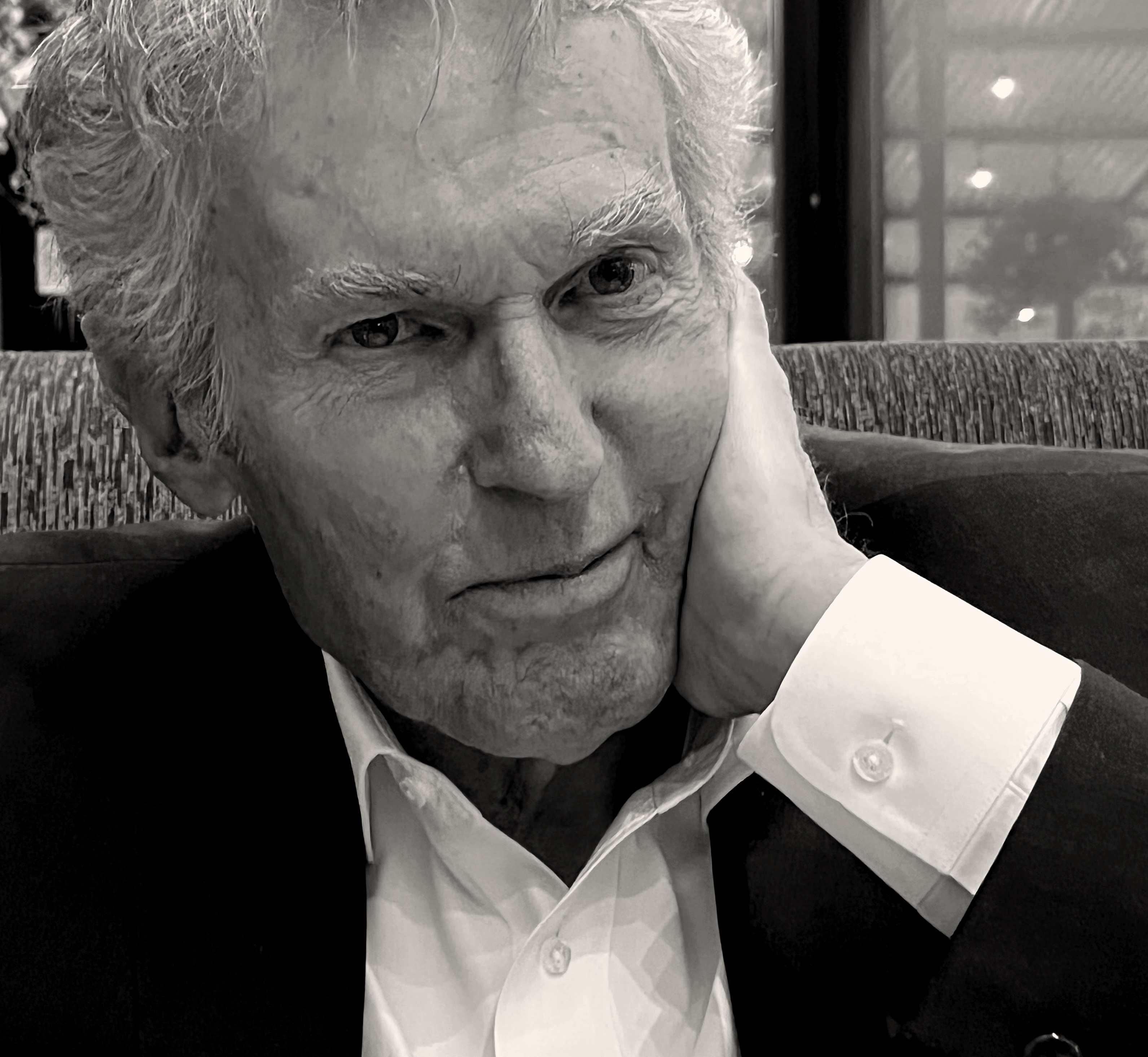
Cris Pulos was unabashedly Greek. His face was a map of the Greek Islands. His moustache, Greek fisherman’s hat and smile are the image I’ll always carry of a truly good man. Some years back he and I traded portrait sessions. The fruit of that effort is up top. He thought he looked old. I thought he was ruggedly handsome. He looked just like Cris Pulos.

Sunday, June 26, 2022

Seco Loop

El Rancho Grande

When I begin a local photo jaunt, I look for the best clouds and head toward them.  I’m searching for the most dramatic sky and something in the foreground to complement the heavens. In some images the foreground element carries the day. In others it’s all about the sky. Since it’s New Mexico there are epic clouds most days. But Friday’s sky began as blah and ended stormy. Monsoon Season is upon us. It's the answer to many a prayer and rain dance. Wildfires have devastated New Mexico over the last month and we hope the steady rain will help our heroic firefighters tame the flames and smoky skies that have hung over Taos since the first of June. 

Dos Caballos Uno

Dos Caballos Dos

I headed north from Taos to the picture postcard village of Arroyo Seco where I always find something worth capturing. I drove through charming Seco, passed Santísima Trinidad church and turned right toward Taos Ski Valley on State Road 150. At 11 o’clock was a classic western scene with a corral, horses, stacked hay bales and horse trailers. I parked at the Post Office across the street and walked toward the corral to photograph these handsome specimens.

Valdez Morada

Next, I drove along the rim and dropped down the steep hill into Valdez, a rural settlement in a verdant valley with a notable morada, a lay chapel built by Los Hermanos de Penitente. The Brothers of Penance practice a harsh faith that includes self-flagellation among its practices. The little morada, in contrast, was glowing and serene.

Brewed with Rocky Mountain Spring Water

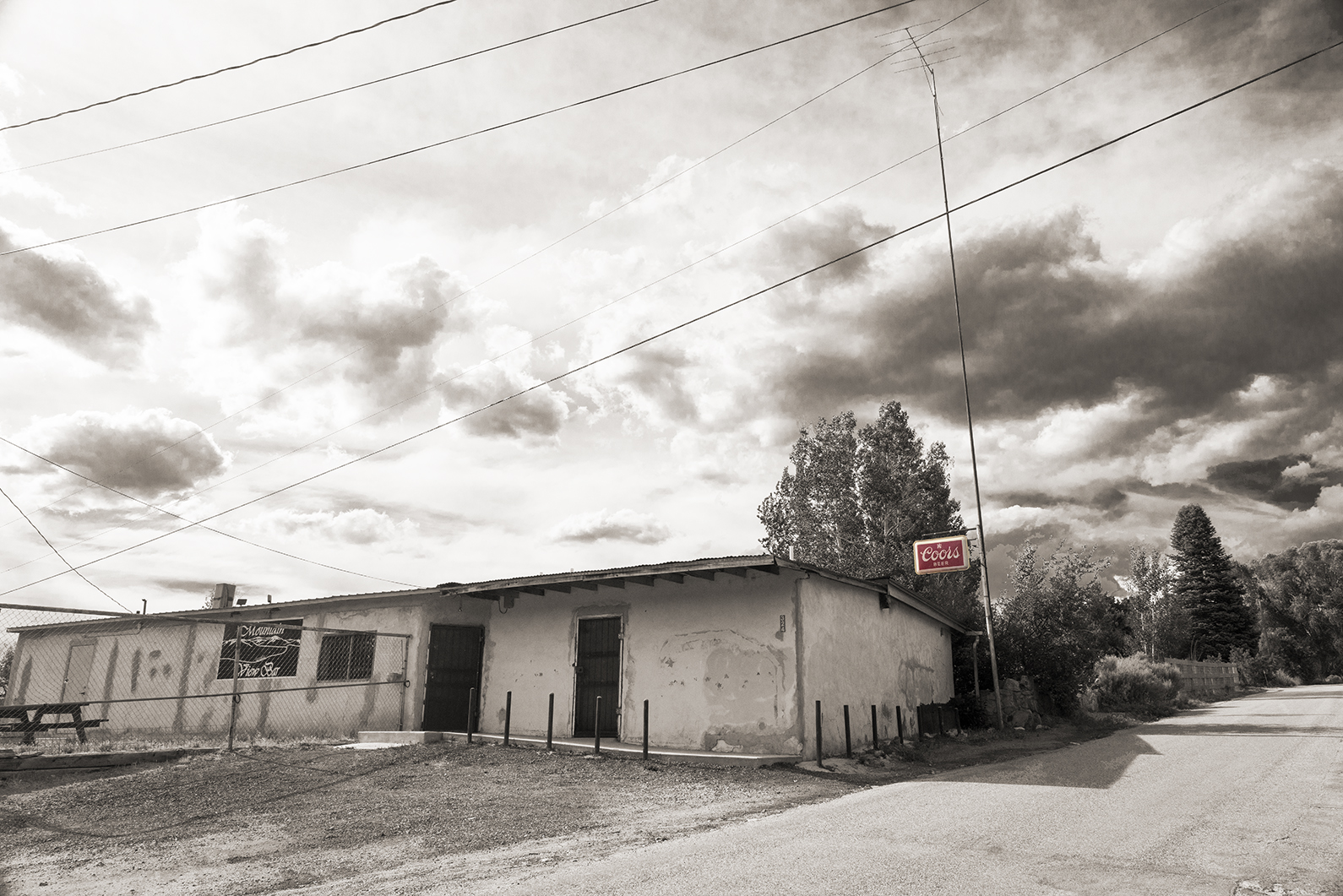
And finally, there's a bar in Valdez, one I've been afraid to enter. Luckily for me the joint was closed.

Sunday, June 19, 2022

Postcards from Chromo

Chromo School established in 1895

We’ve made the jaunt from Taos to Durango dozens of times over the past two decades. And since Peggy has been represented by Sorrel Sky Gallery in Durango for many years, she routinely delivers paintings, attends openings, and teaches workshops there. Durango is a nifty little college town with an eclectic restaurant scene and the best bread between Denver and San Francisco. So, any excuse to visit the place works for me. The bakery is fittingly named Bread.

Schoolhouse and horses

Roof and Clouds

This time we were attending the 20th Anniversary of the gallery. Kind of a big deal. Twenty years in the gallery business is no mean feat and Sorrel Sky has accomplished it with verve and style. The occasion was worthy of a gala celebration and gala it was. Beyond the wonderful art at the gallery owner Shanan Campbell had invited Ken Koshio and his three-man Japanese Taiko drumming troupe to kick off the fiesta. She told the audience that she had heard Ken’s group perform in Scottsdale and knew she had to invite them to headline her 20th anniversary fiesta. Their athletic, high-energy performance left us breathless, and the vibrating drums shook us to our boots. Learn about Ken Koshio at www.kenkoshio.com.

Old meets new

Little house on the prairie

But this post isn’t just about Sorrel Sky or the 20th anniversary splash. It’s about the gorgeous four-hour drive from Taos to Durango and more specifically about the tiny settlement of Chromo that’s sits on Highway 84 three miles north of the New Mexico-Colorado border. The setting of the village that sits beneath Chromo Mountain is magical. It’s classic cowboy movie country that could easily masquerade as Wyoming or Montana.

The star of the show in Chromo is a one room schoolhouse set in a pasture with an outhouse to the rear and a teacherie to the right as we faced the school. Teacherie, I’m left to deduce, is an arcane term for a teacher’s residence. Think infirmary or menagerie but for a spinster schoolmarm braving the wild and wooly west.  The bottom photographs are of the teacherie. According to the plaque on the front of the schoolhouse the facility dates to 1895 and Chromo School is an Approved Standard School whatever that means. And what were the standards in 1895 anyway? Today it's a community center for a prosperous ranching community.

A gaggle of horses grazing on the school’s lawn stopped us in our tracks. It was a first. We’ve driven by the school at least forty times in 18 years and I’ve photographed it on a dozen of those occasions but nary a horse till now. Peggy was driving this time since it was her gig. As we came abreast of the glorious scene passed I yelled, “Stop! Make a U-turn. We have to photograph that.”

And it’s a good thing we did. The horses were gone the next day.

Sunday, June 12, 2022

Detritus

Closed bulk plant, Monticello, Utah

Gas Pumps, Monticello, Utah

Even when you have a photographic mission it’s often subjects that are incidental to the objective that command your attention. That was true in my trip to the Four Corners and the Navajo Nation three weeks back. Sure, I got some worthy shots of the vast Navajo Reservation. And some showed man’s insignificance against the sweep of the vast desert. But the evidence of our feeble efforts to tame a harsh wasteland captured my fancy as much as the otherworldly beauty of the Navajo homeland.

Standard Oil of Cow Springs, AZ

What's left of Tsegi, AZ, Population Zero

Depicting man's fleeting mark has been something of a calling since 2006 when I climbed out of Death Valley to behold the Sierra Nevada looming beyond Lone Pine. Just because it was there I took a left turn to a place called Keeler. Keeler, a withering burg of 66 souls with a median age of about the same sat on the alkaline shore of what had once been a lake. That was before LA stole the water or, more accurately, the citizens of the Owens Valley took LA’s money and were left with Keeler and other dusty remnants of a vibrant life under the Sierra’s gaze.

Good Luck, Keeler, CA. 2006
 
Today’s post is a blend of images, one old and the others as new as yesterday. They prove the premise that we can adapt to an unforgiving landscape, but Mother Earth has the last say. In the past and in a fraught present we are faced with that truth. We, in our stunning hubris, ignore the natural world’s power at our peril.

Adobe at Ranchos Plaza

Good Luck
 spawned a portfolio called At the Edge of What's Left. The first four images above join that growing series. Good Luck was my most successful photograph until last year when it was dethroned by Adobe at Ranchos Plaza. It was quite a run.

Thursday, June 09, 2022

Testing Testing Testing

Test Dummy

After a slew of sleepless nights and a chat from 1:37 am to 2:45am Wednesday night with my new best friend Efe in Turkey the kinks in my new email feed may have been ironed out. Of course, I’ve thought that before, like on Tuesday, when the whole enterprise went sideways. Efe and I agreed that the best way to prove we’ve righted the ship is to publish a new blog post as a test of our, mostly his, wizardry. To say my fingers are crossed doesn’t come close to describing my pins and needles. This is that test and I am the test dummy. BP 127/67, Pulse 47, O2 97, Temp 97.6. Not too shabby for an octogenarian.

This post serves to prove that:

1.      It will arrive in a clean white field from Steve Immel Photography.

2.    The title and the entire content of the post will reside within the email. You needn’t click on title to go to the actual blog. Though I wish you would since it’s a much better visual experience.

3.    There will be no advertising or commercial content and, especially, no Turkish text up top.

4.    You will receive the email as described at or about 7:00am Mountain Time on Friday June 10, that is 6am Pacific, 8am Central and 9am Eastern and so forth.

It’s that simple or difficult depending on your vantage point. Right now these simple goals are feeling mighty lofty.

I’ll leave you with these questions.

Do you prefer the whole post be included in the email, so you don’t have to go to the blog?

Would you like to receive the title and a snippet of the text, say 150 characters, and you decide if you want to click on the title to see the whole post?

Or how about the minimalist approach of title only and you’d always have click through to see the actual post.

Tuesday, June 07, 2022

Transition Blues

We are not amused

The transition from Feedburner to follow.it as my blog’s email feed has been painful. I apologize for the late posts, ugly emails, and languages you don’t understand. At this anxious moment I think that I, with the steadfast guidance of Efe at follow.it, have remedied our problems. Think, I must emphasize, is well shy of believe. Please hang in there with me as I sort it out. Thank you.

In the interest of proving that all is right and ready, I’m publishing this short, contrite post that, if our adjustments work, will arrive on time from Steve Immel Photography without ads for Dr. Phil and fungus ointments.

Should that prove to be the case you’ll  be able to read the whole blog in the email you receive or can click on the title, in this case Transition Blues, to see a more polished version of the post. That’s how it’s been with Feedburner the last sixteen years. An alternative I’ve seriously considered is for the email to include the title and a snippet of the post, say the first 50 words, and you would click on the title to read the blog. What do you think about that permutation?

Sunday, June 05, 2022

Folded. Heavy Starch

Barrel Cuff and wrist

When I unfolded my heavy starched 100% Egyptian cotton dress shirt and put it on Friday night I was gripped with delight at the feel and look of the crisp white shirt and the cylinder of cloth that formed a barrel around my wrist. The actual name of the cuff is barrel cuff for obvious reasons. The moment took me on a journey from the deep past to the here and now.

A cuff within a cuff

It harkened back to the early sixties when a more worldly college friend, Duane Henry, sold me on the virtues of an Oxford cloth dress shirt that was professionally laundered, starched, pressed, and always folded. The look of a white Gant button down with the slightly rolled collar was a dash of savoir faire that made an impressionable youngster into a pretend Ivy Leaguer in his soft shouldered gray flannel suit, regimental stripe tie and glistening cordovan brogans. Later I graduated to the superior Sero buttondown with longer collar and more impressive roll. Both Gant and Sero hail from the Ivy League mecca of New Haven, Connecticut. For decades there was a billboard on I-95 announcing the city as the home of Gant shirts. Yale, too.

I’ve had my dress shirts laundered and prepared as described above since 1962 thanks to Duane’s sound advice. My handsome Linea Uomo shirt beneath my Italian Joseph Abboud Super 120s suit was a such a fine sight to see on Durango’s Main Avenue Friday. Or is the nostalgia clouding my sensibilities?

And speaking of a properly laundered, starched, ironed, and folded shirt, for our first sixteen years in Taos there was no such animal. There was just one laundry whose operators wouldn’t know a barrel cuff from a pickup truck. Nor, for that matter, would they care. Their idea of ironing a so-called barrel cuff is to iron a crease into the poor thing. I nearly left this burg more than once because I couldn’t get decent shirt. If we ever move again the town will have to provide a laundry that does a proper shirt and we can buy an authentic baguette.

Don’t get me started on bad bread.

I must credit a new addition to Taos’s pantheon of great services. Thanks to Clean Taos for the exemplar of fine shirt handling shown in these iphone shots by my bride Peggy. Manipulation of the images and conversion to black and white was accomplished by the wearer of said shirt.

This post, you should know, is the first using follow.it rather than Feedburner to feed or send the blog. It’d been a rocky road these last weeks, just getting my posts to you. I haven’t been able to choose the publishing time which has ranged from five to 72 hours after the time I’ve selected. Hence the change. I’ve spent the week making the switch and I’m on pins and needles about the change. I will not deactivate Feedburner until I know follow.it is working. Please tolerate the duplication if you get two emails with the post. And, if you’re up to it, let me know that you received it. Thanks for that.

Have a glorious week.

Sunday, May 29, 2022

Navajo Visions

Though I didn’t knock it out of the park when I photographed the Four Corners and the Navajo Nation a couple of weeks ago there was a smattering of photographs that spoke to the vastness and solitude of the big empty.


South of Blanding on my way to Flagstaff at the junction of the roads to Montezuma Creek and Mexican Hat I encountered the abandoned headquarters of Wild Rivers Expeditions tucked into a red mesa. In the process I discovered Bluff Dwellings, a new high-end resort across Highway 191. It was only six months ago that I stayed in Bluff and pronounced it dead in the water despite its red mesas, Comb Ridge, and the San Juan River that flows through it. Somebody with deep pockets has greater vision than I do.


Heading south a few miles north of the Arizona border I spotted a Navajo homestead below a bluff and two mesas. It was a sweet habitation in charmed location, the kind of setting that fills my chest. Then a day later driving back to Taos through Thoreau and Crownpoint, NM I photographed an iconic Diné rancho replete with a Hogan and corrals. It dawned on me I had photographed that very scene at least ten years ago. I didn’t even remember I had driven the road till I saw the picturesque outfit. I drove dozens of mile without a dwelling half an hour at a stretch without another vehicle.


A few miles past the homestead I came upon a scattered community strewn along the hillside outside Torreon. A friend was a nurse practitioner at the Navajo Clinic in Torreon for 15 years after as many years doing the same in Nepal. She told us that the Navajo Nation was as close to a third world country as she could find in America. I wouldn't argue the point.


And, finally, a duel between two icons outside Shiprock.

Sunday, May 22, 2022

Zuma Zuma Zuma


It’s 8:30 Sunday night and I’ve slaved over photographs from my recent trip to Navajo Country for days. And while I whined about the proceeds of 72 hours in that serenely empty land, I can see promise in the work that I damned so strongly in may last post. And considering that revelation, I need more time to properly manipulate the images. Manipulate is such a harsh word.


Yesterday, Sunday, I spent the morning at David Michael Kennedy’s studio in the village of El Rito, NM. It was at his amazing studio that I first met the master photographer and world class raconteur. The dude can tell a story. It must have been a decade ago. On that occasion we purchased a small palladium print of a Longhorn steer. It’s a treasure that's hung in a place of honor in the Immel abode. When we bought the piece, I didn’t have the cash or a check and at the time he didn’t take credit cards. I told him my sad story and he said, “No problem. Send me a check. I know where to find you.” I’m pretty sure I paid him, but you never know. You’ve heard the story.

Today I bought a photograph of Bob Dylan that David took at Dylan’s Zuma Beach home in 1985. The location, Zuma Beach, was a selling point. It’s the beach where my cohort of Art Center students spent many a weekend. No, I was not a student. I was an insurance adjuster. Zuma Beach was also the namesake of our Mexican restaurant in Boston, not to mention the name of Neil Young’s 1975 album. My Zuma period was 1961. That spread dates me in a big way since Neil Young is a 100 years old. Then again he has Daryl Hannah.
David’s photograph of Dylan is a moody piece that looks unposed, just the way like it. Why isn’t there an image included in this post? Well, because I don’t have a file with which a make a quality thumbnail. That will wait for later.

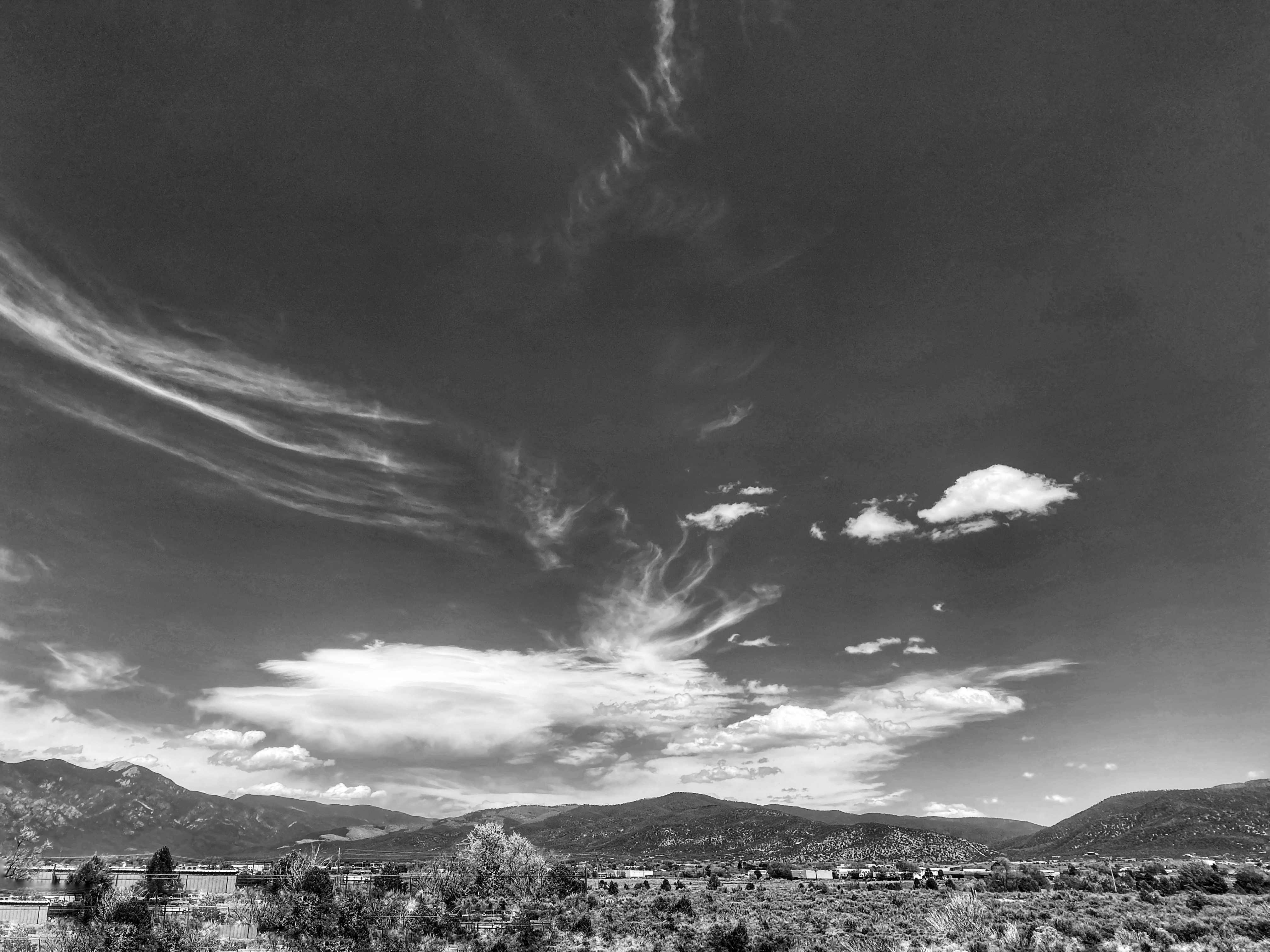
Instead, here’s what I saw on my drive back to Taos from El Rito.

Sunday, May 15, 2022

Apocalypse Now


It’s one hell of a note when your best images were made in hour four of a 72-hour photo safari. Except for the set included here my efforts in my latest sortie into Navajo Country were wanting. I fear that I ventured forth with less than a full tank, inspirationally speaking.


I had planned the trip with a clear objective, to create more and better photographs for the July-August issue of Shadow and Light magazine. Then I discovered I’d inverted issues. The article was for the May-June issue, so I had the three days to write the thing. That meant I’d have to make do with the photographs in hand. Thankfully the photographs did the trick. They supported the story Cruel Beauty, uh, beautifully.

So, my motivation for the trip was dampened. I didn’t really have to go. But I thought, “What the hell? You’ve already blocked the time. It’ll be fun and you do love the Navajo Nation.” I packed for week and was back in three days which tells you everything you need to know.

This grouping was made in 60mph winds while I was blasted by Shiprock, New Mexico’s finest sand. It was a scene from the apocalypse. The end was nigh and all I got was a mouth full of grit and these six dandies. These were all taken at high noon though the blowing sand turned day to dusk in some of them. That's the silhouette of Shiprock itself obscured by a veil of blowing sand in the bottom photograph.

As to Shadow and Light, I’m in my fourth year as a regular contributor. My byline is called Telling Stories. In the May-June issue I juxtapose the Navajo Nation’s breathtaking beauty and rich culture with the reality of its “temporal deprivation” as I call it in the story.

Heads up. I'll be forwarding a special subscription offer for the worthy online magazine in the next couple of days.