Sunday, November 08, 2015

Back to San Antone

As I was finishing breakfast on Tuesday the phone rang. It was an Alamosa, Colorado number that I didn’t recognize at first. When I answered it was Andrew Abeyta telling me that the sheep were on the way to San Antonio Mountain from Mogote at that very moment. He said “They’ll be there by noon. The trailer will be on the west side of 285 and on the north side of San Antone.” I tossed it around for about three seconds and said, “I’ll be there.”

I threw together a cheese, salami and apple lunch, poured myself a roadie of coffee and set off, figuring an hour to get there. As I headed north on 285 and came abreast of the mountain I began looking for signs of Andrew, Victor and the sheep. Just across from Victor’s usual site between two hills on the Taos Plateau I saw a shimmering object that I thought was trailer, but no sheep. I proceeded to the Colorado border and still no sheep. I went back to find the trailer and this time found a rutted path to the shoulder of Mount San Antonio, took it toward the mountain and found Andrew setting up the trailer for Cuba.


I parked the Pilot out of the picture and walked to the trailer. He greeted me and predicted, “Cuba should be coming over the hill anytime.” I followed him over the rise and we scanned the horizon for the herder and sheep. After five minutes or so Andrew exclaimed. “There he is. He’s wearing an orange hat.” And, indeed, a single figure and 365 wooly bulges spread across the llano.


The figures came closer and closer as Cuba trailed the sheep around the hill below us. Andrew brought a trough and filled it with salt. “The sheep will really want this after walking eight miles.” The moment they arrived they attacked the salt then wandered down to the pond below for refreshment. Andrew told me, “In the winter they don’t drink much. Maybe every two days. Besides they eat snow. When it’s hot they need a lot of water. Having water already here saves a lot of money. Otherwise I have to bring it every day.”


While the sheep drank their fill, Andrew and Cuba went about setting up the propane generator and connecting electrical to the campo before driving down to the pond so Cuba could be sure every sheep was accounted for.


Sunday, November 01, 2015

Ocate

I first heard of Ocate during a one person show in Fort Collins back in 2010. Quite by chance the noted equine photographer Tony Stromberg was having an opening the same night. It was a drizzly April evening with very little action so I found myself wandering back and forth between my show and Tony’s. He did the same. In a snippet of conversation Tony described the horse sanctuary that he managed and spoke in spiritual terms about the rescued horses and life lessons they had taught him. He told me that his operation was in Ocate, New Mexico, a place somewhere between nowhere and oblivion. He said he had to drive to Mora for a tank of gas and to Las Vegas to find a real store. It sounded grim but it's lilting moniker stuck with me.

Last Saturday after we picked up a couple of Peggy’s paintings from the Kennedy Museum at New Mexico Highlands University we took the great circle route back to Taos through, you guessed it, Ocate. Being a man of the plains, figuratively speaking, the grasslands through which we drove were a tonic and the epic New Mexico sky enveloped us as only it can.


Wowzer! That's a sky.

Sunday, October 25, 2015

Ignore Me Fred. Act like I'm not here.

Fred Black whom I've written about in the past is an extraordinary weaver. Peggy and I can pick out Fred’s spectacular rugs from across an aircraft hangar. And, as I have said, Fred is a man of many talents, a pilot, an architect, a high level martial artist and a tango dancer, the last two pursuits with his wife, my fellow photographer, writer and dear friend Daryl Black.

A highlight of the fall art season in Taos is the Taos Wool Fest and within it Fred’s booth which reigns supreme among the dozens of stalls and displays. After leaving the Taos Fall Art Festival’s four venues we crossed Paseo del Pueblo Norte and entered Kit Carson Park to see the churro sheep and alpacas, the hordes of wool aficionados and, most of all, Fred’s rugs. They are not shown here except in the blurred background in image number one. Instead here are a couple of candids of the steely eyed weaver himself.

Ignore me Fred. Act like I’m not here.


Sunday, October 18, 2015

Intimate Histories

It was mid-September and I was heading toward to the Cruces Basin Wilderness with one last chance to find and photograph my amigo Victor “Cuba” Hernandez at his high camp. Maybe ten miles west of US 285 on FR 87 just beyond San Antonio Mountain my journey was brought to a screeching halt by bridge construction just ahead, an event with two results. First, I have yet to visit Cuba at his mountain Shangri-La and it won't be this year. That sheep has left the barn. And second, it propelled me into the fallback subject revealed here.

With mission one aborted I turned back to a nameless wildlife sanctuary I'd spied on the way in, nameless not because it had no name but because I've already forgotten it. It was last month after all. I hopped the locked gate, always a plus, and walked a rutted path to a discarded homestead with two buildings and a concrete foundation with a rusted water tank. Set in a grassy valley running west toward Laguna Larga the ruins whispered intimate histories into my ears. 


Sunday, October 11, 2015

Whining Aside


All whining aside I did get one dollop of fog during my second annual coastal California safari. By the time I reached for my second breakfast scone in Tomales the soup lifted and another sunny day in paradise reared its lovely head. These came during the five mile drive from my tiny cottage at Canvas Ranch to the nearly as tiny village of Tomales. Apres sconces I drove up the coast to Fort Ross and the towering redwoods of northern Sonoma beneath which I camped as a wee laddie around 1950.


Sunday, October 04, 2015

Found Art Redux

Years ago I launched a series called Found Art which deals with, for want of a better phrase, street art and artistic assemblages of ordinary stuff. Here are a couple in which great care was exhibited by the artist to "assemble" stones just so or, as in image two, to carefully wire and weld garden tools, muffler pipes and other detritus into zoomey sculpture.

On Museum Hill in Santa Fe

By the roadside in Rinconada, NM
Folks make art out of pretty much whatever's available. Always have. Always will.

Sunday, September 27, 2015

Life's a blur then you die

Seldom do I post a couple of pics and call it a day. But prompted by my friend Terry Thompson’s vivid abstracts currently displayed in the Taos Fall Arts Festival and because fall color is upon us here are two autumn leafy items that celebrate the season with applied blur. That means I created the fuzz with rapid zooms of my trusty 28mm-135mm.


That's all folks.

Sunday, September 20, 2015

Unbreakable and forever

I spent Friday morning with the nearly famous sheep herder, Victor “Cuba” Hernandez and his patron, Andrew Abeyta. I awoke at 4:15, sacrificed my morning shave and arrived in Mogote about 15 minutes early for the trek to the place where Cuba and the sheep would cross the Rio de Los Pinos just south of Osier, Colorado. Cuba had left his last camp in the high country at about 7am and would trail the sheep back to the Abeyta ranch in Mogote by day’s end. I bailed about noon having photographed the crossing and just enough sheep butts to have had my fill.

When I spoke to Andrew earlier in the week I asked if he had found a herder in South America He said, “I was looking in Peru but Victor decided he wanted to stay another year.” I replied that it had to be a relief not to have to train somebody new. Andrew continued that, “It’s not a big surprise. He’s said he was going to stop several times and always decides to stay. This time he said he’d keep on doing it as long as he can walk.” 


Naturally I’m delighted with the news since Cuba has been the constant in the story and is the embodiment of the sheep herding cycle in the San Luis Valley. Besides I didn’t get to his high camp in Cruces Basin and now will have another shot next year.

Sipping coffee and leaning on his pick-up Andrew explained that once the sheep arrived at the river there was no telling when they would cross. They might just hang out and graze for half an hour and decide it’s time. And that's precisely the way it happened..


As Andrew and I chatted while we waited for Cuba I asked some questions that would help me chronicle his family’s history as sheep ranchers and, more importantly, to understand the deep attachment that they have to the land and the life they have pursued since that first orphan lamb nearly a century ago. While I have a better handle on the chronology of their story I'm still a country mile from understanding why their tie to the land and the ranching life is so strong. Strong, in fact, doesn’t come close to describing the depth of Los Abeytas' roots in the life of land, water, family and faith. It seems to be unbreakable and forever.

Sunday, September 13, 2015

Fogish

On the morning of my last day in Sonoma there was something resembling fog though it was more like chicken broth than split pea soup and lasted about ten minutes.

Down the road five miles from the Canvas Ranch was tiny Tomales with the clapboard sided Church of the Assumption in the early morning's diffuse light and further south Marshall’s shimmering tidal flats opening into Tomales Bay.


Sunday, September 06, 2015

Nothing but blue skies do I see

The image called "Canopy" on the way to the lighthouse in 2014

The last time we visited Point Reyes the lighthouse was shrouded in fog and the 300 steps down to the jutting promontory were closed to visitors who might otherwise pitch to the crashing surf below. When I returned in July of this year I was hoping for socked in conditions that would provide fodder for my Fog Series. Instead I got blue skies, bright sun and seventy degree temperatures. Good for the suntan but hell for the Fog Series.

You’re getting these damned scenics because your trusted reporter couldn’t extract something transcendent in the sunshine.

I turned right at the spot where Canopy was shot last year and got the empty beach reaching north

Point Reyes Light with the too blue Pacific beyond

More of same

Does black and white bring gravitas or is it just me?


Sunday, August 30, 2015

Skeletal Remains

This little number has been posing on the periphery for a while. The portrait of the cactus as an old man has patiently waited its turn while I’ve been getting all gooey about California’s Central and Northern coasts. No longer little guy.

Dessicated and spiney with a texture like Balsa Wood

The skeletal remains of a towering Saguaro come to you from Saguaro National Park West near Tucson. It appeared while Peggy and our good friend, the noted painter Stephen Day, set-up for a day of plein air painting in the park. She’s always said the Sonoran Desert is her favorite of America’s great deserts. I'm conflicted. It's a definite maybe.

Sunday, August 23, 2015

Singular as a snowflake


After coffee, a scrumptious pastry and topping off the tank I left Cambria and headed north on PCH. The first site of note was San Simeon Beach, part of William Randolph Hearst’s storied castle and ranch complex and a California State Park. Jutting 300 yards into the crescent cove was a long pier probing blue water and the open Pacific. To the north San Simeon Point, a hillside resplendent with Eucalyptus and Bishop Pines, buffered the cove. A handful of fishermen silently fished for calico surfperch, jacksmelt  and boccacio.

Piers and the pilings on which they stand create receding repetitions that draw the eye into the scene while the surf's frothy residue forms intricate patterns, each as singular as a snowflake.


There's a subtle difference between the two immediately above. The first is toned black and white the second color. Which one works best? I encourage you to enter the actual website and click on the images to make them fill the screen. Lots of detail in the last one especially.

Sunday, August 16, 2015

The gold in the Golden State

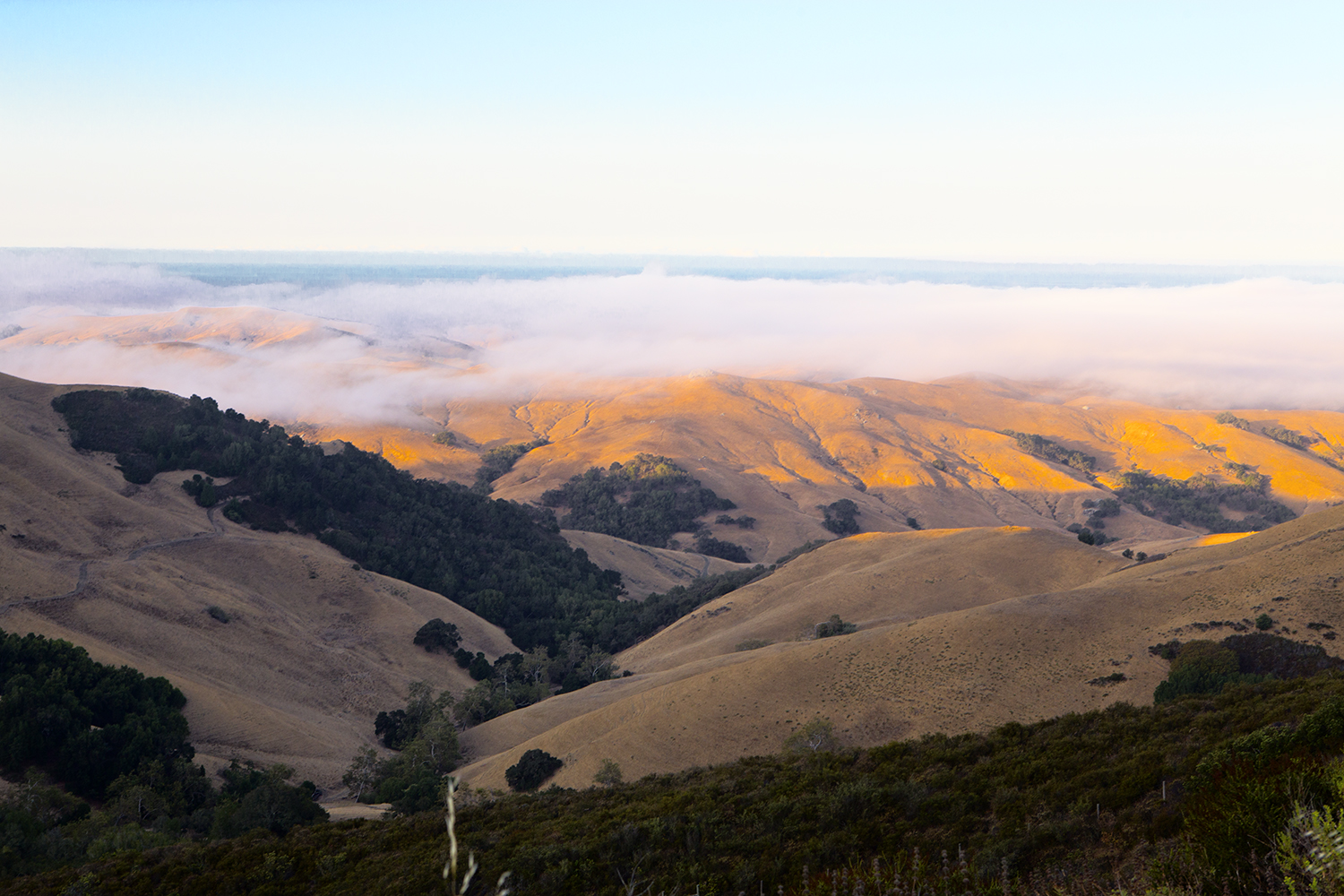
Spending years three through ten in Central and Northern California I have a warm spot for the rolling hills and Oaks that epitomize the area. From our last California dwelling we could hike the foothills above San Leandro which in the late forties were barren of development. There was an outcropping where we would enjoy a picnic lunch and that we named Eagle Rock or so I remember. To the surprise of absolutely nobody that open space is now a sea of modest homes. It was at Lake Chabot, a county park nestled in those hills, that I was stung by about a million bees. There was crying involved if I’m not mistaken.

Earlier, in our end of the war Salinas days, we often ventured to Monterey, Pacific Grove and Carmel. That would have been by public transport since didn’t have wheels until more than a decade later. Our path from Salinas took us through the very landscape that that these photographs depict. Those grassy knolls and hillocks say California like nothing else. 

On the morning that I photographed Harold and Pat Glasco, the subjects of last week's post, I made some early morning photographs of a glowing hillside that had just been shorn of its Wheatgrass. That left the graded soil the color and texture of a Jersey cow and made the iconic Oaks really pop.


Then, for good measure, there are these golden rollers reaching down to the Pacific between Cayucos and Cambria.


Middle California's decor package starts with tan carpet spread across undulating hills from San Diego's North County to the upper reaches of Sonoma. That's the better part of 400 miles south to north and fifty miles across from the coast to the San Joaquin Valley. That's enough acreage to make it the dominant feature of coastal Cal. It makes me wonder what the early Spanish must have thought when they beheld such an Eden.


Sunday, August 09, 2015

Harold and Pat Glasco

Harold and Pat Glasco

Harold and Patricia Glasco were high school sweethearts in mid-1950s Oklahoma. In 1973 during his successful career selling construction steel Harold and his bride bought 37 hillside acres of Paso Robles grass and oaks for the princely sum of $850 an acre. They had it paid off by 1992 and today are sitting on a gold mine of Central Coast farm land. It's a vineyard waiting to happen.

Bindi and Harold

As I was photographing the rolling hills and wineries west of Paso Robles I saw Harold tending his Longhorn “Shorty.” So called I imagine because of the length of his horns, When he had finished his ministrations he pulled alongside for some chit chat and next thing I knew I was at the top of the hill meeting Pat and learning about their path to this extraordinary place. Harold would be the first to say that they were blessed.

Harold in his garden of machinery

He’s a loquacious guy, a great storyteller and a born salesman. He gave me the grand tour of their hilltop aerie which was laden with farm equipment in various states of repair. He showed me the well and pump he himself installed and the rainfall jottings he logged every year. Once it was 50 inches a year. Last year it was 10.

Later that night back at my motel Harold called to tell me that he had forgotten to show me a cave on his property and that I should come back the next day. A dark o'clock start up the coast precluded that so I’ll have to take a raincheck from my new friend.   

Sunday, August 02, 2015

Valley Dry

A tinder dry nut farm west of Wasco where our business is roses and prisons

Heading west toward Paso Robles on Highway 46 the California drought grabs you by the throat. California’s San Joaquin Valley, the fruit basket of the nation, is described in textbooks as “semi-arid” but right now it looks like the westward migration of the Mojave Desert. At least that’s the case without irrigation.

More and more plots are lying fallow as precious water is preserved and signs offer sprawling parcels of farmland but attract with few buyers.

Prime farmland or soon to be beachfront property near Blackwell's Crossing where James Dean met his maker.

What do you call an irrigation ditch without water? Desert.
At Blackwell's Crossing with the Coast Range in the distance